

How Do The Foreign Service And The Office Of Secratary Of Defence
The President
The president is very influential in US foreign policy, and directs the nation'due south war-waging, treaties, and diplomatic relations.
Learning Objectives
Explain the President's potency every bit Commander-in-Chief of the United States
Primal Takeaways
Key Points
- Throughout the course of their fourth dimension in function, well-nigh presidents gravitate towards foreign policy. It is oft argued that the president has more autonomy in strange policy as compared to domestic policy.
- The president is commander-in-chief of the armed forces, merely only Congress has authority to declare state of war and provide funding. The State of war Powers Act attempted to limit the president'southward war-waging powers.
- The president has the power to make treaties, with a ii-thirds vote of the Senate, and has the power to make international agreements.
- The president is the principal diplomat equally caput of state. The president tin can also influence foreign policy by appointing US diplomats and foreign help workers.
Key Terms
- treaty: A bounden agreement nether international constabulary concluded by subjects of international law, namely states and international organizations.
- War Powers Act: A federal law intended to check the President's ability to commit the Usa to an armed conflict without the consent of Congress.
- congressional-executive agreements: An accord fabricated by articulation authority of the Congress and the President covering areas of International Constabulary that are not inside the ambit of treaties.
The President's Influence on US Foreign Policy
Presidents have more power and responsibility in foreign and defense policy than in domestic affairs. They are the commanders in main of the war machine; they determine how and when to wage state of war. As America' chief diplomat, the president has the ability to make treaties to be approved past the Senate. And as caput of land, the president speaks for the nation to other world leaders and receives ambassadors.
Presidents nearly always point to foreign policy every bit evidence of their term 'due south success. Domestic policy wonk Bill Clinton metamorphosed into a foreign policy enthusiast from 1993 to 2001. Even prior to 9/11, the notoriously untraveled George W. Bush underwent the same transformation. President Obama has been just as involved, if non more, in strange policy than his predecessors. Congress—as long as information technology is consulted—is less inclined to claiming presidential initiatives in strange policy than in domestic policy. The idea that the president has greater autonomy in strange than domestic policy is known as the "2 Presidencies Thesis."
The President and Waging War
The President is the Commander-in-Chief of the U.s.a. Armed forces and as such has broad authority over the war machine. Nevertheless, but Congress has dominance to declare war and decide the civilian and war machine budget.
War powers provide a key avenue for presidents to deed in foreign policy. After the nine/11 attacks, President Bush's Office of Legal Counsel argued that as commander in chief President Bush could do what was necessary to protect the American people. Since World War II, presidents accept never asked Congress for (or received) a declaration of war. Instead, they relied on open-ended congressional authorizations to use force, United Nations resolutions, Due north American Treaty Arrangement (NATO) actions, and orchestrated requests from tiny international organizations like the System of Eastern Caribbean States.
Congress tin react against undeclared wars by cutting funds for armed services interventions. Such efforts are time consuming and not in place until long after the initial incursion. Congress's most concerted effort to restrict presidential state of war powers, the State of war Powers Act, passed despite President Nixon's veto in 1973. It was established to limit presidential state of war powers, but information technology gave presidents the right to commit troops for sixty days with but the conditions being to consult with and report to Congress—atmospheric condition presidents often feel free to ignore. Since Vietnam, the act has washed little to preclude presidents from unilaterally launching invasions.
President Obama did not seek congressional potency before ordering the US military machine to join attacks on the Libyan air defenses and authorities forces in March 2011. After the bombing campaign started, Obama sent Congress a alphabetic character contending that equally Commander-in-Primary he had constitutional authority for the attacks. White House lawyers used the distinction betwixt "limited military operation" and "state of war" to justify this.
The President, Treaties, and Agreements
Article Ii, Section 2 of the United states Constitution grants power to the president to brand treaties with the "advice and consent " of two-thirds of the Senate. This is different from normal legislation which requires approval past elementary majorities in both the Senate and the Firm of Representatives..
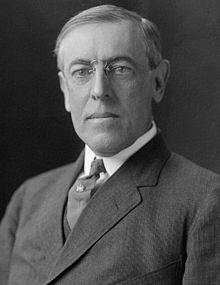
President Wilson: Wilson had disagreements with Congress over how the peace treaty ending Globe War I should be handled. Presidents oftentimes have a wide range of influence on US foreign policy.
Throughout U.S. history, the President has also made international "agreements" through congressional-executive agreements (CEAs) that are ratified with only a majority from both houses of Congress, or sole-executive agreements made by the President alone. The Supreme Court of the Us has considered congressional-executive and sole-executive agreements to be valid, and they have been common throughout American history.
The President and Diplomacy
Another section of the Constitution that gives the president power over strange diplomacy is Article 2, Department two, Clause ii of the United states Constitution, known as the Appointments Clause. This clause empowers the President to appoint certain public officials with the "advice and consent" of the Senate. This clause also allows lower-level officials to be appointed without the communication and consent procedure. Thus, the President is responsible for the appointment of both upper- and lower-level diplomats and foreign-assist workers.
For case, the U.s.a. Secretary of State is the Strange Minister of the United states of america and the primary usher of state-to-state affairs. Both the Secretary of State and ambassadors are appointed past the President, with the advice and consent of the Senate.
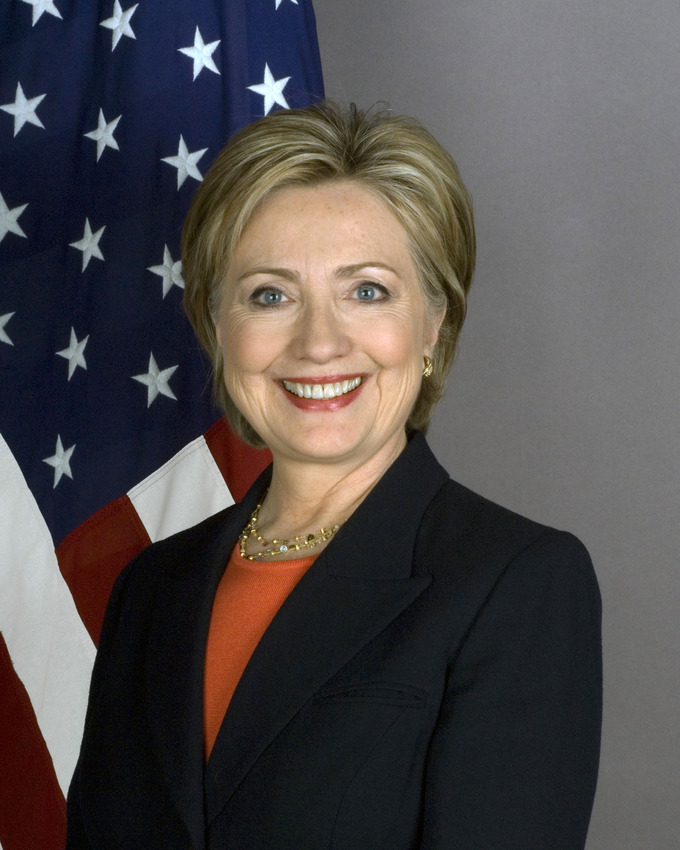
Hillary Rodham Clinton: Hillary Clinton served equally Secretary of State, which is the US'due south Strange Minister. The President has the ability to appoint diplomats (such equally the Secretary of State), giving him or her substantial influence in U.s.a. foreign policy.
Every bit head of country, the President serves equally the nation'south top diplomat. Presidents are frequently depicted as speaking for and symbolically embodying the nation: giving a State of the Union address, welcoming foreign leaders, traveling abroad, or representing the United States at an international briefing. All of these duties serve an important office in Us foreign policy.
The Chiffonier
The secretary of state and secretary of defense play primal roles in assisting the president with strange policy.
Learning Objectives
Compare and contrast the roles of the Secretary of Land and Secretary of Defense in U.S. foreign policy
Key Takeaways
Key Points
- The secretary of country assists the president in strange affairs and advises him on representatives and international relations.
- The secretary of defence force, amongst other things, advises the president on military diplomacy and hot spots throughout the earth.
- Since 9/11 many functions of the secretary of state has been shifted to other departments and so the secretary can focus on pressing foreign matters.
Key Terms
- commander-in-chief: A commander-in-master is the person exercising supreme command potency over a nation's armed forces forces or significant chemical element of those forces.
The presidential cabinet has several secretaries who aid the president in foreign affairs. This includes the secretary of land and the secretary of defense force.
The United States Secretarial assistant of State is the head of the United States Department of Land, which is concerned with foreign affairs. The Secretary is a member of the chiffonier and the highest-ranking chiffonier secretarial assistant both in line of succession and order of precedence. The current Secretary of State is John Kerry, the 68thursday person to agree the mail service. The specific duties of the Secretary of State include:
- Organizes and supervises the entire United States Section of Country and the United States Strange Service.
- Advises the President on matters relating to U.S. strange policy, including the date of diplomatic representatives to other nations, and on the acceptance or dismissal of representatives from other nations.
- Participates in high-level negotiations with other countries, either bilaterally or equally part of an international briefing or organization, or appoints representatives to do so. This includes the negotiation of international treaties and other agreements.
- Responsible for overall direction, coordination, and supervision of interdepartmental activities of the U.S. Government overseas.
- Provides data and services to U.S. citizens living or traveling abroad. Besides provides credentials in the form of passports and visas.
- Supervises the United States immigration policy at home and abroad.
- Communicates issues relating the United States strange policy to Congress and U.S. citizens.
Nigh of the domestic functions of the Department of Country accept been transferred to other agencies. Those that remain include storage and use of the Smashing Seal of the United States, performance of protocol functions for the White Business firm, and the drafting of certain proclamations. The Secretary also negotiates with the private states over the extradition of fugitives to strange countries. Under Federal Law, the resignation of a President or of a Vice-President is only valid if declared in writing in an instrument delivered to the office of the Secretary of State. Appropriately, the resignations of President Nixon and of Vice-President Spiro Agnew, domestic issues, were formalized in instruments delivered to the Secretary of Country.
As the highest-ranking fellow member of the cabinet, the Secretary of State is the third-highest official of the executive co-operative of the Federal Government of the United states of america, after the President and Vice President. The Secretarial assistant of State is 4th in line to succeed the Presidency, coming after the Vice President, the Speaker of the House of Representatives, and the President Pro Tempore of the Senate. Six Secretaries of Country have gone on to be elected President.
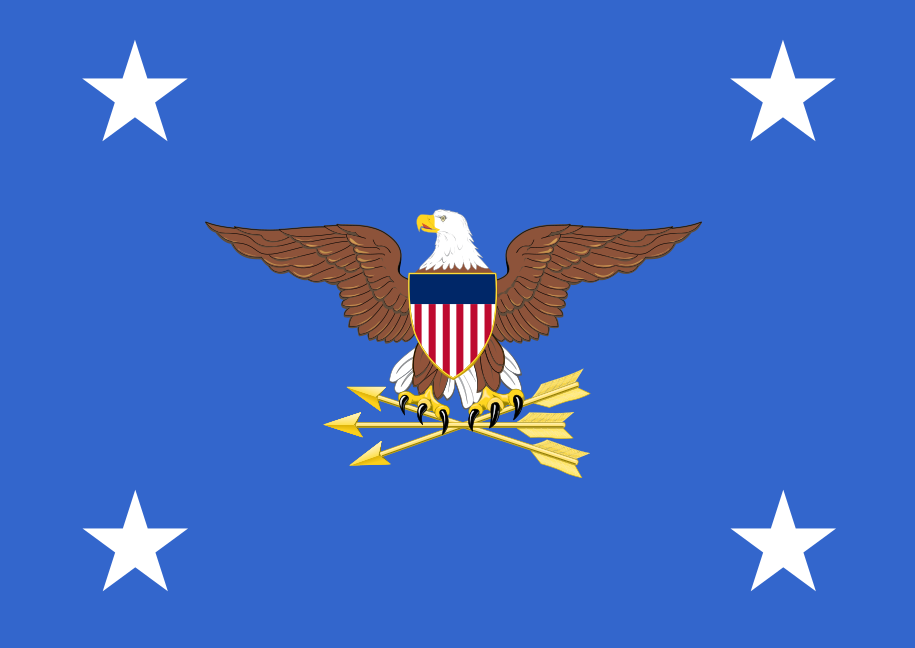
Flag of the Secretarial assistant of Defense: The flag of the secretary of defense.
Every bit the head of the United States Foreign Service, the Secretary of State is responsible for managing the diplomatic service of the United states of america. The foreign service employs about 12,000 people domestically and internationally. It supports 265 United States Diplomatic missions around the world, including ambassadors to various nations.
The Secretarial assistant of Defense is the head and chief executive officer of the Section of Defence, which is an Executive Department of the Regime of the United States of America. This position corresponds to what is generally known as a defence Minister in many other countries. The Secretary of Defense is appointed by the president with the advice and consent of the senate. The private is by custom a member of the cabinet and past law a member of the National Security Council.
The Secretary of Defense force is in the chain of command and exercises control and control, field of study only to the orders of the President, over all Department of Defense forces (Army, Navy, Air Force, and Marine Corps) for both operational and administrative purposes. Only the Secretarial assistant of Defense (or the President) can authorize the transfer of operational control of forces between the three Military Departments and between the combatant commands. Because the Office of Secretary of Defense is vested with legal powers which exceeds those of any deputed officer, and is 2d only to the Office of President in the military bureaucracy, it has sometimes unofficially been referred to equally a de facto "deputy commander-in-chief. " The Chairman of the Joint Chiefs of Staff is the principal armed forces adviser to the Secretary of Defence and the President. While the Chairman may assistance the Secretary and President in their command functions, the Chairman is not in the chain of command.Secretary of Defense force is a statutory function. It is the general provision in administrative police that provides that the Secretary of Defence has "dominance, direction and command over the Department of Defense force. " The Secretarial assistant of Defense force is farther designated past the same statute every bit "the chief assistant to the President in all matters relating to the Section of Defense force. " Ensuring civilian control of the military, an individual may not be appointed equally Secretary of Defense inside vii years afterward relief from active duty equally a commissioned officer of a regular (i.e., non-reserve) component of an armed force.
The Hierarchy
Prominent bureaucratic organizations shaping U.S. foreign policy include the State Department, the Defense force Department, and the CIA.
Learning Objectives
Compare and contrast the roles of the State Section, the Defense Department, and the Central Intelligence Agency in shaping U.S. strange policy.
Key Takeaways
Key Points
- The State Section 'southward responsibilities include protecting and assisting U.S. citizens living or traveling abroad; profitable U.S. businesses in the international market; and coordinating and providing support for international activities of other U.S. agencies.
- The Section of Defence force is the executive department of the U.S. authorities concerned directly with national security and the U.South. military.
- The Primal Intelligence Agency (CIA) is an independent civilian intelligence agency of the U.South. government that provides national security intelligence assessments to senior U.S. policymakers.
Primal Terms
- diplomatic immunity: A diplomat's immunity to prosecution and/or litigation nether local law.
- tactical: of, or relating to military operations that are smaller or more local than strategic ones
There are several bureaucratic organizations that are actively involved in shaping U.Due south. foreign policy. Prominent among them are the State Department, the Defence force Department, and the Key Intelligence Agency.
The United States Department of State (DoS), often referred to as the Country Department, is the U.Southward. federal executive department responsible for the international relations of the United states, equivalent to the strange ministries of other countries. The Department was created in 1789 and was the first executive department established. The Department is led past the Secretarial assistant of State, who is nominated by the President, confirmed past the Senate, and is a member of the Cabinet. Every bit stated by the Department of State, its purpose includes:

U.S. State Department: The Land Section is one bureaucratic agency that shapes U.S. foreign policy
- Protecting and assisting U.S. citizens living or traveling abroad;
- Assisting U.Southward. businesses in the international market place;
- Coordinating and providing support for international activities of other U.Southward. agencies (local, country, or federal government), official visits overseas and at home, and other diplomatic efforts.
- Keeping the public informed nigh U.Due south. foreign policy and relations with other countries and providing feedback from the public to administration officials.
- Providing automobile registration for non-diplomatic staff vehicles and the vehicles of diplomats of foreign countries having diplomatic immunity in the United states
The Section of Defense (also known every bit the Defense Department, USDOD, DOD, DoD or the Pentagon) is the executive department of the U.S. government charged with coordinating and supervising all agencies and functions of the government concerned directly with national security and the U.Due south. armed forces. The Department – headed by the Secretary of Defense – has three subordinate war machine departments: the Department of the Army, the Section of the Navy, and the Department of the Air Strength. The Military Departments are each headed by their ain Secretarial assistant, appointed by the President, with the advice and consent of the Senate.
The Central Intelligence Bureau (CIA) is an contained civilian intelligence agency of the U.S. government. It is an executive agency that reports directly to the Director of National Intelligence with responsibility for providing national security intelligence assessments to senior U.Due south. policymakers. Intelligence-gathering, a core function of the agency, is performed by not-armed services deputed noncombatant intelligence agents, many of whom are trained to avoid tactical situations. The CIA also oversees and sometimes engages in tactical and covert activities at the asking of the U.South. President. Oftentimes, when such field operations are organized, the U.South. military machine or other warfare tacticians deport these tactical operations out on behalf of the agency while the CIA oversees them.
Congress
Two constitutional clauses, the Constitution and Strange Commerce Clause and the War Ability Clause, give Congress foreign policy powers.
Learning Objectives
Evaluate the War Powers Clause and how the United States' process of declaring and entering into war has changed over time, identifying the general role that Congress plays in making and analogous foreign policy
Key Takeaways
Fundamental Points
- The War Power clause states that only Congress can declare war. This has been evoked five times in American history.
- Sometimes, this clause direct conflicts with what the president wants to do. As a upshot, the president will create a " police activeness " in a hostile territory instead of declaring war.
- Trade is also an important policy -making tool. Congress has the ability to regulate foreign trade.
Key Terms
- police force action: Law action in war machine/security studies and international relations is a euphemism for a war machine activeness undertaken without a formal announcement of war.
Congress is given several powers to engage in foreign policy, just also to cheque the president'south actions strange policy, peculiarly in the issue of war. Perhaps the most important powers are in the State of war Power Clause which was given to Congress in the Constitution and Foreign Commerce Clause. This clause provides Congress with the power to regulate commerce overseas. V wars have been alleged nether the Constitution: the War of 1812, the Mexican-American War, the Spanish-American War, World War I, and World State of war 2.
In the instance of the Mexican-American War, President James Polk explained that Texas was about to become a part of United States of America. Mexico threatened to invade Texas. The President gathered troops near Corpus Christi. U.S. troops moved into an area in which the new international boundary was being disputed. Mexican troops moved into the same area and the two forces clashed. The President claimed that Mexico had passed the boundary into the United States. Some individuals in Congress, including Abraham Lincoln, wondered if this was true.
Nevertheless, U.S. presidents have not sought formal declarations of war ofttimes. Instead, they maintain that they have the Constitutional authorisation, as commander in master to use the military machine for "police actions. " According to historian Thomas Wood, "Always since the Korean, Commodity Two, Department ii of the Constitution — which refers to the president as the 'Commander in Chief of the Army and Navy of the U.s.' — has been interpreted to mean that the president may act with an essentially free hand in strange affairs, or at the very least that he may send men into battle without consulting Congress. " Some people have argued this could pass as offensive actions, although historically police deportment fell mostly under the purview of protecting embassies, U.S. citizens overseas, and aircraft such as the quasi war.
The Korean War was the offset modern example of the U.Southward. going to war without a formal announcement. This has been repeated in every armed conflict since that time. Notwithstanding, beginning with the Vietnam, Congress has given other forms of authorizations to declare war. Some debate continues about whether the deportment are appropriate. The tendency of the Executive Branch to engage in the origination of such a button, its marketing, and even propagandizing or related activities to generate such support is also highly debated.
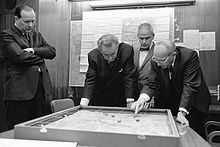
Johnson and His Advisors: Johnson being shown a map of an area in Vietnam. The police activity spiraled into a war-like state of affairs apace, although it was one war never waged by Congress.
Therefore, in light of the speculation concerning the Gulf of Tonkin and the possible abuse of the authorization that followed, Congress passed the War Powers Resolution in 1973. It requires the president to obtain either a annunciation of state of war or a resolution authorizing the use of force from Congress within lx days of initiating hostilities with a full disclosure of facts in the process. The constitutionality of the resolution has never been settled. Some presidents have criticized it equally an unconstitutional encroachment upon the president.
Some legal scholars maintain that offensive, non-law military actions, while a quorum can however be convened, taken without a formal Congressional declaration of war is unconstitutional. They believe this because no subpoena with 2-thirds majority of states has inverse the original intent to make the State of war Powers Resolution legally bounden. However, the Supreme Court has never ruled direct on the matter and to date no counter-resolutions have come up to a vote. This separation of powers stalemate effect creates a "functional," if not unanimous, governmental stance and event on the matter.
The Commerce Clause in the Constitution likewise give Congress the power to regulate merchandise between nations. The Commerce Clause is an enumerated list in the United States Constitution. The clause states that the United States Congress shall accept ability "to regulate Commerce with foreign Nations, and amid the several States, and with the Indian Tribes. " These powers are sometimes discussed as separate powers, only they are essentially of import considering trade is considered to be an important form of economic diplomacy between the Us and strange nations.
Interest Groups
Foreign policy interest groups are domestic advocacy organizations which seek to influence the regime's strange policy.
Learning Objectives
Illustrate how involvement groups influence U.S. foreign policy
Key Takeaways
Key Points
- In society to build and maintain their influence, they use tactics such as framing the upshot and shaping the terms of debate, offering information and analysis to elected representatives, and monitoring the policy process and reacting to it.
- Foreign policy interest groups often overlap with so-called "ethnic" interest groups, as they effort to influence the strange policy of the Us for the benefit of the foreign "indigenous kin" or homeland with whom respective ethnic groups identify.
- Though ethnic interest groups have existed for many decades, they have become a particularly influential phenomenon since the end of the Common cold State of war.
Key Terms
- advancement: The human activity of arguing in favor of, or supporting something.
Foreign policy interest groups, which are domestic advocacy organizations seeking to directly or indirectly influence the government 's foreign policy, are a key player in U.Southward. strange policy.
According to U.South. scholar John Dietrich, these interest groups have mobilized to represent a diverse assortment of business concern, labor, ethnic, human rights, ecology, and other organizations. In order to build and maintain their influence, they use tactics, such as framing the issue and shaping the terms of debate; offering information and analysis to elected representatives (who may not have the fourth dimension to enquiry the outcome himself or herself); and monitoring the policy process and reacting to information technology through disseminating supplementary data, letter-writing campaigns, calling for additional hearings or legislation, and supporting or opposing candidates during elections.
Foreign policy involvement groups often overlap with so-called "ethnic" interest groups, as they endeavor to influence the strange policy and, to a bottom extent, the domestic policy of the United States for the benefit of the foreign "ethnic kin" or homeland with whom respective indigenous groups place. Though indigenous interest groups have existed for many decades, they have become a specially influential phenomenon since the stop of the Cold War.
According to political scientist Thomas Ambrosio, this is a result of growing acceptance that indigenous identity groups accept the right to mobilize politically for the purpose of influencing U.S. policies at home and away. Prominent examples of these organizations include the American Israel Public Affairs Committee, the Cuban American National Foundation, the Armenian Associates of America, the U.S.-India Political Action Committee, and the National Iranian American Council.

the American Israel Public Affairs Committee: The American State of israel Public Diplomacy Commission is a prominent strange policy involvement group
The Media
The media has inverse how citizens perceive and approach almost U.S. Foreign Policy in the 20th century.
Learning Objectives
Explain the media's role in setting the agenda for foreign policy debate
Cardinal Takeaways
Key Points
- The media is about influential when it covers foreign policy that directly affects Americans, especially affairs with which Americans are not acquainted.
- Vietnam was a time when many people watched the horrors of war on television. This helped the popularity of the war sink.
- Subsequently these viewings, the military founds itself involved in politics and having to exercise impairment control to ease the public'south and the politicians' concerns.
Key Terms
- media: Ways and institutions for publishing and broadcasting information.
- media bias: A bias in journalistic reporting, in programming selection, etc., in mass communications media.
Agenda -Setting in Strange Policy
1 way in which the media could set the agenda is if it is in an area in which very few Americans have direct cognition of the problems. This applies to strange policy. When American military personnel are involved, the media needs to study considering the personnel are related to the American public. The media is also likely to have an interest in reporting issues that have substantial effects on American workers, such as major merchandise agreements with Mexico during the NAFTA negotiations in the 1990'southward.
David McKay, author of American Politics and Society, lists as one of the three main distortions of information by the media, "Placing high priority on American news to the detriment of foreign news. And when the U.S. is engaged in military action abroad, this 'foreign news' crowds out other foreign news. "
News Media and the Vietnam War
In the media'south virtually famous example in involvement on foreign affairs was its involvement in the Vietnam War. From forty press corpsmen in 1964, the number in South Vietnam had grown to 282 by January 1966. By August that number had jumped to 419. Of the 282 at the first of the year, only 110 were Americans. 67 were Due south Vietnamese, 26 Japanese, 24 British, 13 Korean, eleven French, and seven German. The media caught many combat events, ordinarily on live television set, which prompted many American citizens to be concerned near foreign policy.
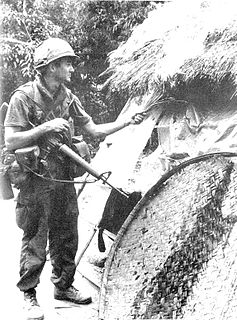
Soldier in Vietnam: Graphics like this helped contribute to Americans' concern over foreign policy in Vietnam.
The U.Due south. Mission and the MACV (Military Help Control) besides installed an "information czar," the U.S. Mission's Government minister-Counselor for Public Affairs, Barry Zorthian, brash General William Westmoreland on public affairs matters. He had theoretical responsibility nether the ambassador for the development of all data policy. He maintained liaison between the diplomatic mission, MACV, and the press; publicized information to refute erroneous and misleading news stories; and sought to assist the Saigon correspondents in covering the side of the war most favorable to the policies of the U.S. government. Zorthian possessed both experience with the media and a great deal of patience and tact while maintaining reasonably good relations with the press corps. Media correspondents were invited to attend nightly MACV briefings covering the mean solar day'due south events that became known as the "Five O'Clock Follies. " Most correspondents considered these briefings to exist a waste product of time. The Saigon bureau chiefs were likewise often invited to closed sessions at which presentations would be made by a briefing officer, the CIA station chief, or an official from the embassy who would present background or off-the-record data on upcoming military operations or Vietnamese political events.
According to Daniel Hallin, the dramatic structure of the uncensored "living room war" as reported during 1965–1967 remained simple and traditional: "the forces of good were locked in battle once once again with the forces of evil. What began to modify in 1967 was the confidence that the forces of good would inevitably prevail. " During late 1967 the MACV had likewise begun to condone the decision it had fabricated at the Honolulu Conference that the armed forces should exit the justification of the war to elected officials in Washington. The military establish itself drawn progressively into politics, to the point that information technology had become as involved in "selling" the war to the American public equally the political appointees it served. This change would take far-reaching detrimental furnishings.
Media Bias
A cocky-described liberal media watchdog group, Fairness and Accuracy in Reporting (Fair), in consultation with the Survey and Evaluation Research Laboratory at Virginia Commonwealth University, sponsored an bookish study in which journalists were asked a range of questions about how they did their piece of work and almost how they viewed the quality of media coverage in the broad expanse of politics and economic policy. "They were asked for their opinions and views about a range of recent policy bug and debates. Finally, they were asked for demographic and identifying information, including their political orientation." They then compared to the same or similar questions posed with "the public" based on Gallup, and Pew Trust polls. Their study concluded that a majority of journalists, although relatively liberal on social policies, were significantly to the right of the public on economic, labor, health intendance, and foreign policy issues.

How Do The Foreign Service And The Office Of Secratary Of Defence,
Source: https://courses.lumenlearning.com/boundless-politicalscience/chapter/who-makes-u-s-foreign-policy/
Posted by: bushcraight.blogspot.com
0 Response to "How Do The Foreign Service And The Office Of Secratary Of Defence"
Post a Comment