

What Is The Hour Of Service For A Bus Driver
Hours of Service (HOS) regulations are issued by the Federal Motor Carrier Safe Administration (FMCSA) and govern the working hours of anyone operating a commercial motor vehicle (CMV) in the United States. These regulations apply to truck drivers, commercial and intercity bus drivers, and school bus drivers who operate CMVs. These rules limit the number of daily and weekly hours spent driving and working, and regulate the minimum amount of time drivers must spend resting between driving shifts. For intrastate commerce, the corresponding state'southward regulations apply.
The FMCSA is a partitioning of the Us Section of Transportation (DOT), which is by and large responsible for enforcement of FMCSA regulations. The commuter of a CMV is required to go on a tape of working hours using a log book, outlining the full number of hours spent driving and resting, too as the fourth dimension at which the change of duty status occurred. In lieu of a log volume, a motor carrier may keep track of a driver's hours using Electronic Logging Devices (ELDs), which automatically record the amount of time spent driving the vehicle.
The HOS'southward primary purpose is to prevent accidents caused by commuter fatigue. This is accomplished past limiting the number of driving hours per day, and the number of driving and working hours per week. Fatigue is also prevented by keeping drivers on a 21- to 24-hour schedule, maintaining a natural sleep/wake cycle (or cyclic rhythm). Drivers are required to take a daily minimum catamenia of rest, and are allowed longer "weekend" rest periods to gainsay cumulative fatigue effects that accumulate on a weekly basis.
Enforcement of the HOS is by and large handled by DOT officers of each land, and are sometimes checked when CMVs pass through weigh stations. Drivers found to be in violation of the HOS tin be forced to stop driving for a sure menses of time, which may negatively bear on the motor carrier'southward safety rating. Requests to change the HOS are a source of contentious debate, and many surveys indicate some drivers become away with routinely violating the HOS. These facts take started some other debate on whether motor carriers should be required to use ELDs in their vehicles, instead of relying on paper-based log books.
Purpose [edit]

Drivers subject field to the HOS include any driver of a vehicle which has a gross vehicle weight of 10,001 pounds (4,536 kg) or more; which is designed or used to transport more than 8 passengers (including the commuter) for bounty; which is designed or used to ship more than xv passengers (including the driver) and is not used to transport passengers for compensation; or which is used to transport chancy materials in quantities requiring the vehicle to be marked or placarded under the chancy materials regulations.[two]
The purpose of the HOS is to reduce accidents acquired by driver fatigue. As the graph to the right illustrates, the number of hours spent driving has a potent correlation to the number of fatigue-related accidents. According to numerous studies, the gamble of fatigue is also greatest between the hours of midnight and six in the morning, and increases with the total length of the driver's trip.[2] The blanket assignment of midnight as the time of day when all drivers gain fresh hours may therefore not exist the safest choice possible.
The FMCSA identifies three master factors in driver fatigue: Circadian rhythm effects, sleep impecuniousness and cumulative fatigue effects, and industrial or "time-on-job" fatigue.
Cyclic rhythm effects depict the tendency for humans to feel a normal cycle in considerateness and sleepiness through the 24-hour day. Those with a conventional sleep pattern (sleeping for seven or 8 hours at night) feel periods of maximum fatigue in the early hours of the morn and a lesser period in the early on afternoon. During the depression points of this cycle, 1 experiences reduced attentiveness. During the loftier points, it is hard to sleep soundly. The cycle is anchored in part past ambience lighting (darkness causes a person's trunk to release the hormone melatonin, which induces sleep),[3] and by a person's imposed pattern of regular sleeping and waking times. The influence of the day-night cycle is never fully displaced (standard artificial lighting is not stiff enough to inhibit the release of melatonin),[4] and the performance of night shift workers usually suffers. Circadian rhythms are persistent, and tin can only be shifted past one to two hours forward or backward per day. Changing the starting fourth dimension of a work shift by more than these amounts volition reduce attentiveness, which is common after the first dark shift post-obit a "weekend" break during which conventional slumber times were followed.[one]
Sleep impecuniousness and cumulative fatigue effects describe how individuals who fail to have an adequate menses of sleep (7–8 hours in 24 hours) or who have been awake longer than the conventional 16–17 hours will suffer slumber deprivation. A slumber deficit accumulates with successive slumber-deprived days, and additional fatigue may be caused by breaking daily sleep into two shorter periods in place of a single unbroken period of sleep. A sleep deficit is not instantly reduced by 1 night's sleep; it may take two or three conventional sleep cycles for an individual to render to unimpaired operation.[ane]
Industrial or "time-on-task" fatigue describes fatigue that is accumulated during the working period, and affects performance at dissimilar times during the shift. Performance declines the longer a person is engaged in a task, gradually during the showtime few hours and more steeply toward the end of a long period at work. Reduced performance has likewise been observed in the kickoff 60 minutes of work as an individual adjusts to the working environment.[1]
Definition of terms [edit]
Parts of a driver's work solar day are defined in four terms: On-duty time, off-duty time, driving fourth dimension, and sleeper berth fourth dimension.
FMCSA regulation §395.2 states:[v]
On-duty time is all fourth dimension from when a driver begins to work or is required to exist in readiness to work until the driver is relieved from work and all responsibleness for performing work.
- On-duty time includes:
- All time at a plant, terminal, facility, or other property of a motor carrier or shipper, or on any public property, waiting to be dispatched, unless the driver has been relieved from duty by the motor carrier.
- All time inspecting, servicing, or conditioning whatever CMV at any time.
- Crossing a border
- All driving fourth dimension every bit divers in the term "driving time".
- All time, other than driving time, in or upon any CMV except time spent resting in a sleeper berth.
- All fourth dimension loading or unloading a CMV, supervising, or assisting in the loading or unloading, attention a CMV existence loaded or unloaded, remaining in readiness to operate the CMV, or in giving or receiving receipts for shipments loaded or unloaded.
- All time repairing, obtaining assist, or remaining in attendance upon a disabled CMV.
- All fourth dimension spent providing a jiff sample or urine specimen, including travel time to and from the collection site, to comply with the random, reasonable suspicion, mail service-accident, or follow-up drug testing.
- Performing any other work in the capacity, employ, or service of a motor carrier.
- Performing any compensated work for a person who is not a motor carrier. (This rule does not explicitly forbid a driver from obtaining a 2nd or part-time chore. It but prevents a commuter switching from a not-driving chore to a driving chore without the required 10 hours of remainder.)
Driving time is all time spent at the driving controls of a CMV.

The sleeper berth is the area toward the rear of the truck cab (with the night tinted windows).
Sleeper booth fourth dimension is any amount of time spent within the sleeper berth (e.g., resting or sleeping). FMCSA regulation §393.76 gives the minimum requirements for a space to be defined as a sleeper berth.[half-dozen] The simple definition is an area separate from (usually immediately behind) the driving controls that includes a bed. The rules practise not explicitly crave that a driver must sleep, just that a driver must take a menses of "residual" within the sleeper booth or off-duty (i.e., domicile). A statement made past the ICC in 1937 gives the reason: "Nosotros take no command over the fashion in which a commuter may spend his fourth dimension off-duty, although some of his spare time activities may tire him as much as whatever work would do. We tin can only emphasize, by this comment, the responsibility which is the driver'due south ain to assure himself of adequate rest and sleep, in the fourth dimension bachelor for this purpose, to ensure rubber of his driving, and likewise the employer's responsibility to come across that his drivers report for piece of work in fit condition."[2]
Off-duty fourth dimension is whatsoever time not spent on-duty, driving, or in the sleeper berth.
History [edit]
| Summary of changes to the hours of service | ||||||||||
|---|---|---|---|---|---|---|---|---|---|---|
| Twelvemonth Enforced | Driving Hours | On-Duty Hours | Off-Duty Hours | Minimum Duty Bicycle | Maximum Hours On-Duty Before 30 Minute Remainder Break | |||||
| 1938 | 12 | fifteen | 9 | 24 | None | |||||
| 1939 | 10 | None | 8 | 24 | None | |||||
| 1962 | 10 | xv | viii | 18 | None | |||||
| 2003i | xi | fourteen | 10 | 21 | None | |||||
| 20131 | 11 | fourteen | 10 | 34[vii] | viii | 1 Applies to property-carrying vehicles merely. | ||||
In 1938, the now-abolished Interstate Commerce Commission (ICC) enforced the first HOS rules.[2] Drivers were limited to 12 hours of work within a 15-60 minutes catamenia. Work was divers as loading, unloading, driving, handling freight, preparing reports, preparing vehicles for service, or performing any other duty pertaining to the transportation of passengers or property. [2] The ICC intended the 3-hour difference between 15 hours on-duty and 12 hours of work to be used for meals and remainder breaks. The weekly maximum was limited to 60 hours over 7 days (non-daily drivers), or 70 hours over 8 days (daily drivers). These rules immune for 12 hours of work inside a 15-hour period, 9 hours of rest, with 3 hours for breaks within a 24-60 minutes day.
Within a brusque time, however, representatives of organized labor (including the American Federation of Labor, the Teamsters, and the International Association of Machinists) petitioned for a stay of the original regulations. A few motor carriers fabricated a similar request. The ICC agreed, and oral arguments were heard once again. Labor wanted HOS limits of 8 hours per 24-hour interval and 48 hours per week. The ICC commented "there was no statistical or other information which would enable [them] to say definitely how long a commuter can safely work."[2]
The bear witness before united states clearly does not suffice to enable us to conclude that a duty catamenia as depression as 8 hours in 24 is required in the involvement of rubber. We may telephone call attending, as did the division, to the dissimilarity between factory operations, generally sustained in grapheme, and the operation of buses and trucks, mostly characterized by frequent stops ... because of weather condition encountered in highway and street traffic. The monotony or nervous and physical strain of driving such vehicles is alleviated by these breaks in the periods devoted to driving, and the period of actual work is considerably below the period on-duty.
—July 12, 1938[two], in Interstate Commerce Committee
Within vi months of the original ruling, the ICC ultimately decided to change the 12-hour work limit in 24 hours to a 10-hr driving limit in 24 hours, and the 15-60 minutes on-duty limit was rescinded. Motor carriers were required to requite drivers eight, rather than 9, sequent hours off-duty each day.[two] These rules allowed for 10 hours of driving and 8 hours of rest within a 24-hour solar day.
In 1962, for reasons it never conspicuously explained, the ICC eliminated the 24-60 minutes cycle rule,[2] and reinstated the 15-hour on-duty limit.[8] With x hours of driving and 8 hours of sleep, drivers were allowed to maintain an 18-60 minutes cycle, disrupting the driver'south natural 24-hr circadian rhythm. This change allowed upward to sixteen hours of driving per day, allowing the driver to exhaust their weekly limits in as little as five days. Later, an added exception for trucks equipped with sleeper berths meant drivers were immune to "split" their 8-60 minutes off-duty time into ii parts. With the new splitting provision, a driver could take 2 4-60 minutes periods of rest. Using one of these brusque residuum periods would effectively "stop the on-duty clock", allowing the driver to carve up the 15-hour on-duty fourth dimension limit into two parts likewise. These rules allowed for 10 hours of work within a 15-hour fourth dimension limit, and viii hours of residue within an 18-hour day.[two]
Between 1962 and 2003, there were numerous proposals to change the HOS again, only none were ever finalized. By this time, the ICC had been abolished, and regulations were now issued by the FMCSA. The 2003 changes applied simply to property-carrying drivers (i.eastward., truck drivers). These rules immune xi hours of driving within a 14-60 minutes period, and required x hours of rest.[ix] These changes would allow drivers (using the entire 14-hour on-duty period) to maintain a natural 24-hr bicycle, with a bare minimum 21-hour wheel (11 hours driving, x hours rest). However, the retention of the split sleeper booth provision would let drivers to maintain irregular, short-burst sleeping schedules.
The almost notable alter of 2003 was the introduction of the "34-hour restart." Before the alter, drivers could only proceeds more weekly driving hours with the passing of each day (which reduced their 70-hour full past the number of hours driven on the earliest mean solar day of the weekly cycle). After the change, drivers were allowed to "reset" their weekly 70-hr limit to naught, by taking 34 consecutive hours off-duty. This provision was introduced to combat the cumulative fatigue effects that accumulate on a weekly basis, and to allow for two full nights of residuum (e.g., during a weekend intermission).[two]
In 2005, the FMCSA changed the rules over again, practically eliminating the dissever sleeper berth provision.[10] Drivers are now required to have a total eight hours of rest, with 2 hours allowed for off-duty periods, for a total of 10 hours off-duty. This provision forced drivers to accept i longer uninterrupted period of rest, but eliminated the flexibility of allowing drivers to take naps during the twenty-four hour period without jeopardizing their driving time. Today's rule still allows them to "split" the sleeper berth period, just 1 of the splits must be 8 hours long and the remaining 2 hours do not stop the 14-hour on-duty period. This rule is confusing and impractical for virtually drivers, resulting in the majority of drivers taking the full x-hour pause.[11] [12]
In the years since 2005, groups such equally Public Citizen Litigation Group, Parents Against Tired Truckers (PATT), Owner-Operator Independent Drivers Association (OOIDA), Citizens for Reliable and Safety Highways (CRASH, which has merged with PATT), and the American Trucking Associations (ATA), have been working to alter the HOS again.[11] [13] [xiv] [15] Each group has their own ideas most what should exist changed, and dissimilar agendas on why the rules should be inverse.
Property-carrying vehicles [edit]

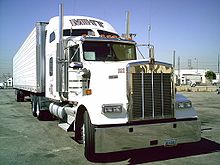
A belongings-carrying vehicle
FMCSA rules prohibit driving a property-conveying CMV (e.thousand., trucks) more than 11 hours or to bulldoze after having been on-duty for 14 hours. The iii-hr difference between the eleven-hr driving limit and the fourteen-hr on-duty limit gives drivers the opportunity to accept care of non-driving working duties such as loading and unloading cargo, fueling the vehicle, and required vehicle inspections, also as non-working duties such as meal and rest breaks. Subsequently completing an 11- to 14-60 minutes on-duty period, the driver must spend 10 hours off-duty.[16]
FMCSA rules prohibit drivers from operating a CMV after having been on-duty sixty hours in 7 consecutive days (if the motor carrier does not operate CMVs every twenty-four hours of the week), or later having been on-duty seventy hours in 8 sequent days (if the motor carrier operates CMVs every day of the calendar week).[xvi]
After accumulating, for case, lxx hours of driving and on-duty time inside a period of eight days, a driver's daily driving limit may be reduced (seventy / 8 = viii.75 driving hours per 24-hour interval). A driver may be allowed (but not required) to have 34 hours off-duty to reset the weekly total back to goose egg (also known as a "34-hour restart").[16]
Passenger-conveying vehicles [edit]
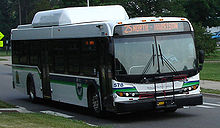
A rider-carrying vehicle
FMCSA rules prohibit driving a passenger-conveying CMV (eastward.g., commercial and intercity buses, passenger vans, and school buses) for more than 10 hours, or to drive later having been on-duty for 15 hours. The 5-60 minutes difference between the 10-hour driving limit and the xv-hour on-duty limit gives drivers the opportunity to take care of non-driving work-related duties such as loading and unloading of passengers and baggage, and fueling the vehicle, as well every bit non-working duties such every bit meal and remainder breaks. After completing a ten to 15-hour on-duty catamenia, the driver must exist immune viii hours off-duty.[17]
The FMCSA weekly hours limitations for rider-carrying vehicles are identical to those for belongings-carrying vehicles.[17]
Afterward accumulating, for case, 60 hours of driving and on-duty time within a period of 7 days, a driver'due south daily driving limit may be reduced (60 / 7 = viii.57 driving hours per solar day). The commuter of a rider-conveying vehicle may non use the 34-hour restart provision.[x]
Log book [edit]
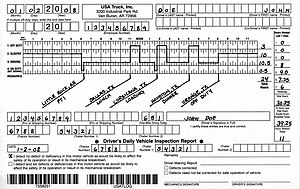
An example of a commuter's log volume, showing the time filigree, cities where the driver has stopped driving, along with the vehicle, driver, and load data.
Every driver of a CMV is required to go along runway of his/her time with a log book[18] or an ELD.[19] A log book is merely a notebook with a grid design on every page, dividing the 24-60 minutes day into 15-infinitesimal (ane/4-hour) segments. Drivers are required to brand carbon copies of each folio, and then one page may be kept with the driver (to be produced upon inspection by DOT officers), then the other re-create may be sent to the driver'due south employer.[18]
Electronic Logging Devices can be thought of as an automated electronic log volume. An ELD records the same data as a manual paper log volume, and requires less input from the driver. The ELD automatically records driving time and location, leaving the driver responsible only for reporting on-duty and off-duty time. In these respects, the ELD is less susceptible to forgery than a paper log book.[20]
FMCSA rules require that a log book (or ELD) must tape for each change of duty condition (eastward.g., the place of reporting for work, or starting to drive), the name of the city, town or hamlet, with state abbreviation. If a modify of duty status occurs at a location other than a city, the highway number and nearest milepost or the nearest two intersecting roadways followed by the name of the nearest city must exist recorded. In addition to the fourth dimension grid, a log volume must record the date, full miles driven for the mean solar day, truck and trailer number, name of carrier, bill of lading number, and the driver's signature. The driver is required to retain a copy of each log folio for the previous seven consecutive days which must exist in his/her possession and bachelor for inspection while on-duty.[18]
Exceptions [edit]
There are numerous exceptions to these rules, some of these include but are not limited to:[21]
- During agin conditions or emergency driving weather, drivers are permitted to exceed the eleven hour maximum daily driving time. However, drivers may non extend the 14 hr on duty time. This changed every bit of September 29, 2020, and now drivers may extend their fourteen-hour limits by up to 2 hours for adverse weather condition. This exception includes unusual traffic atmospheric condition but not recurring traffic conditions which should reasonably take been predictable.
- Drivers who venture less than a 150 air-mile radius from their piece of work reporting location are not required to maintain log books (but are not exempt from limits on driving time), provided their employers maintain accurate records of their driving time.
- Drivers who start and end their work mean solar day at the same location for at least the previous 5 work days may drive by the 14 hour marker, for an extra 2 hours, if 11 driving hours are not exceeded. The 16-hour rule extends the work twenty-four hour period by two hours, but does not extend the allowable driving hours. The xvi-hour dominion may be invoked once per 34 hr reset, if the 5 mean solar day blueprint has been established. The driver must be relieved from work after the 16th hour.
- Drivers for oilfield operations in the petroleum industry, groundwater drilling operations, structure materials, and utility service vehicles are permitted to have a 24-hour restart.
- Retail store drivers who venture less than a 100 air-mile (115.08 statute miles or 185.2 kilometers) radius are allowed to exceed daily driving limits to make shop deliveries from December x to December 25, considering of the demands of the Christmas shopping season.
- Drivers in Alaska can drive up to 15 hours within a 20-hour menses.
- Drivers in Hawaii are not required to maintain log books, provided their employers keep accurate records of their driving time.
- Drivers in California are immune up to 12 driving hours and xvi on duty hours.
- Drivers for theatrical or television move motion picture productions are exempt if the commuter operates inside a 100 air-mile radius of the location where the driver reports to and is released from work. These drivers may take an viii-hour intermission, and are allowed xv hours on duty.
Enforcement [edit]
The HOS are issued, among other manufacture-related regulations, by the FMCSA. In this example, federal regulations apply only to interstate commerce. Commerce which does not involve the crossing of state lines is considered intrastate, and is nether the jurisdiction of the respective country's laws. However, most states accept adopted intrastate regulations which are identical or very similar to the federal HOS regulations.[22]
Enforcement of the HOS rules is generally handled by DOT officers of their respective states, although any ordinary police officer may inspect a driver's log book.[23] States are responsible for maintaining weigh stations[24] commonly located at the borders between states, where drivers are pulled in for random vehicle inspections (although some of the inspections are based on the motor carrier'southward safety rating).[25] Otherwise, a commuter may exist pulled over for random checks by constabulary officers or DOT officials at any fourth dimension. Drivers are required to maintain their log books to current condition, and if inspections reveal whatsoever sort of discrepancy, drivers may be put "out of service" until the commuter has accumulated plenty off-duty fourth dimension to be dorsum in compliance.[26] Beingness put out of service means a driver may not drive his truck during the prescribed limit under hazard of further penalty. Repeated violations can upshot in fines from $1,000 to $xi,000 and a downgrade in the motor carrier's rubber rating.[26]
Long-booty drivers are normally paid by the mile, not by the hr.[27] Legally, truck drivers are not required to receive overtime pay for hours worked in excess of the standard xl-hour work week.[28] Some drivers may choose to violate the HOS to earn more money.[two] [29] Being paid by the mile, whatsoever piece of work performed that is not actual driving is of no value to the driver, providing incentive to falsify the amount of time spent performing not-driving duties.[30] Drivers who falsify their log books often under-report their non-driving duties (such every bit waiting to be loaded and unloaded) which they are not paid for, and under-report their driving time or total miles. Many drivers who receive mileage pay are not paid by logged miles or actual miles,[31] instead, motor carriers apply figurer mapping software (such as PC Miler)[32] or published mileage guides (such as the Rand McNally Household Appurtenances Carriers' Bureau Mileage Guide).[33] PATT suggests that paying all drivers past the hour would reduce HOS violations by removing the incentive to "cheat the organization" by driving more miles than are being logged.[8] Surveys by OOIDA study 80% of drivers are non paid for waiting times while loading and unloading, and the majority of those drivers log these times every bit off-duty (while regulations require they be logged as on-duty). These same drivers reported they would log these times as on-duty if they were paid reasonably for such delays.[ii]
Drivers tin get away with this rule-breaking considering of their newspaper-based log books.[29] Equally drivers tape their time spent behind the wheel, there is very piffling to terminate them from forging their log books.[34] In that location is very superficial oversight and some drivers take advantage of this fact. Surveys signal that betwixt 25% and 75% of drivers violate the HOS.[2] [35] Other drivers maintain more than one log volume, showing falsified versions to enforcement officers.[20]
Trucking companies (motor carriers) tin also play a role in HOS violations.[34] Certain carriers may choose to knowingly ignore HOS violations made by their drivers, or fifty-fifty encourage their drivers to do so. Allowing drivers to violate the HOS is an effective cost-cutting mensurate used more often than not past not-spousal relationship, long haul carriers. Permitting HOS violations allows a carrier to rent fewer drivers, and run on fewer trucks than a company which follows the rules. To comply with the HOS, these companies would take to hire more drivers (peradventure driving up wages) and purchase additional trucks and trailers. Making a change to comply with the law is complicated by competition with carriers that already comply with HOS regulations. Because of this competition, carriers who choose to switch from not-compliance could not pass on all of their increased costs associated with HOS compliance to their customers.[36]
In 1999, ii trucking visitor officials were sentenced to federal prison for violating hours of service regulations. Charles Georgoulakos Jr. and his blood brother, James Georgoulakos were sentenced to 4 months in prison, eight months in dwelling house confinement, and one year of supervised release. Their company, C&J Trucking Company of Londonderry, New Hampshire, was placed on ii years probation and fined $25,000 (the maximum amount). The sentences were the result of an investigation which began when i of the trucking visitor'southward drivers was involved in a standoff on Interstate 93 in Londonderry on Aug. 2, 1995, in which four individuals were killed.[37]
The defendants admitted that they knowingly and willfully permitted employee truck drivers to violate hours of service safety regulations. The corporation executed a scheme to hide illegal hours of driving from detection by Federal Highway Administration (FHWA) safety investigators who bear periodic examinations of trucking companies' records. The scheme involved paying drivers "off the books" for illegal driving time through an business relationship other than the normal payroll business relationship.
— [37], in U.S. Department of Transportation
Several private and public motor carriers such as Frito-Lay,[eight] United Package Service,[8] and Werner Enterprises, have voluntarily implemented electronic on-board recorders to ensure drivers are in compliance with the federal regulations, to reduce the errors and hassles associated with newspaper log books, and to meliorate driver retention and recruitment.[38] EOBRs automatically tape the driving time and cannot exist hands forged. Whatever violation of the HOS will automatically be recorded and reported to the company.
The FMCSA posted a find of proposed dominion making (NPRM) apropos Electronic logging devices (ELD'south), every bit role of the motion to require mandatory ELD's for all carriers, on January xviii, 2007.[39] On Dec xviii, 2017, ELD rules were implemented every bit office of the Congressionally mandated MAP-21 Deed, for all carriers subjected to the record of duty status (RODS) requirements.[40]
he Federal Motor Carrier Safety Administration (FMCSA) announced the Final Rule of the ELD mandate, and ELD regulations beingness implemented in several phases with a compliance date of eighteen December 2017. Fleets had until December 2017 to implement certified ELDs to record hours. Fleets already equipped with loggers or recorders had until December 2019 to ensure compliance with the published specifications
Rewriting the Hours of Service [edit]
Whereas the 11 and 14 hour rules are still in effect, drivers volition besides be required to have a 30-minute break inside the first 8 hours of on duty time. The 34 hour restart provision will still be in effect. However, drivers will only exist allowed 1 restart per week (168 hours). Up to 2 hours either side of a sleeper-berth menses while in the passenger seat will count every bit off-duty. Drivers inside a parked CMV who are not in the sleeper booth must log it as on-duty.[41]
This regulation has been codified into the Final Rule,[42] and will come into force on 27 February 2013 (for the additional Off Duty allowances) and 1 July 2013 (for the break rules, and restart limits).
HOS Final Dominion On December 27, 2011 (76 FR 81133), FMCSA published a final rule amending its hours-of-service (HOS) regulations for drivers of property-carrying commercial motor vehicles (CMVs). The concluding dominion adopted several changes to the HOS regulations, including a new provision requiring drivers to take a rest suspension during the work day nether sure circumstances. Drivers may bulldoze a CMV only if 8 hours or less have passed since the end of the driver's concluding off-duty or sleeper-booth period of at least 30 minutes. FMCSA did not specify when drivers must take the 30-infinitesimal break, but the rule requires that they wait no longer than 8 hours later the final off-duty or sleeper-berth period of that length or longer to have the break. Drivers who already take shorter breaks during the work twenty-four hours could comply with the rule by taking one of the shorter breaks and extending it to xxx minutes. The new requirement took effect on July i, 2013.
On August two, 2013, the U.South. Court of Appeals for the District of Columbia Circuit issued its ruling on the Hours of Service litigation brought past the American Trucking Associations and Public Citizen. The Court upheld the 2011 Hours of Service regulations in all aspects except for the thirty-minute break provision as it applies to short haul drivers. While the decision does not officially take effect until the mandate is issued 52 days afterwards the decision (unless a party files a petition for rehearing, either by the panel or en banc, or moves to stay the mandate pending the filing of a petition for certiorari in the Supreme Court), FMCSA announces the Agency will immediately cease enforcement of the xxx-minute rest break provision of the HOS dominion against short-booty operations. The Agency requests that its State enforcement partners likewise terminate enforcement of this provision. States that do and then will not be found in violation of the Motor Carrier Safety Assistance Program (MCSAP). ENFORCEMENT POLICY Effective August 2, 2013, FMCSA volition no longer enforce 49 CFR 395.3(a)(3)(2) against any driver that qualifies for either of the "short booty operations" exceptions outlined in 49 CFR 395.1(e)(1) or (ii). The Agency requests that State and local enforcement agencies also refrain from enforcing the xxx-infinitesimal rest break against these drivers. Specifically, the post-obit drivers would not be subject to the 30-minute break requirement:
- All drivers (CDL and not-CDL) that operate within 150 air-miles of their normal work reporting location and satisfy the time limitations and record keeping requirements of 395.1(e)(ane).
- Not-CDL drivers that operate inside a 150 air-mile radius of the location where the driver reports for duty and satisfy the time limitations and record keeping requirements of 395.ane
2018 [edit]
An Advanced Notice of Proposed Dominion making (ANPRM) was published in August 2018, to revisit the 2013 HOS rules with possible changes that would include the 30 infinitesimal interruption.[43] The ANPRM is in response to a Congressional mandate and industry concerns that may pb to hours of service rule reforms apropos the air-mile "curt-haul" exemption, modification to the xiv-hour on-duty limitation, revision of the current mandatory 30-infinitesimal interruption for truck drivers after viii hours of continuous driving, and reinstating divide-sleeper berth options.[44]
See also [edit]
- Bus driver
- Commercial driver'southward license
- Drivers' working hours (European Union)
- Federal Motor Carrier Safety Assistants
- List of trucking industry terms in the United states of america
- Public Citizen Litigation Grouping
- Truck driver
- Tachograph
- Trucking industry in the United States
- U.S. Department of Transportation
- Railroad engineer
- Airline pilot
- Helmsman
References [edit]
- ^ a b c d "Regulatory Impact and Small Business organisation Analysis for Hours of Service Options". Federal Motor Carrier Safety Administration. Archived from the original on 26 January 2008. Retrieved 22 Feb 2008.
- ^ a b c d e f one thousand h i j k l m due north Federal Motor Carrier Safety Administration (ii May 2000). "Hours of Service of Drivers; Driver Residuum and Slumber for Safe Operations; Proposed Rule". Federal Register. 65 (85): 25541–25611.
- ^ "Melatonin". University of Maryland Medical Center. Archived from the original on 30 January 2009. Retrieved 30 Jan 2009.
- ^ Czeisler, Charles A. "Pathophysiology and Treatment of Circadian Rhythm Sleep Disorders". Indisposition and Across: The Neurochemical Basis for Targeted Sleep Therapeutics. Medscape. Retrieved 24 April 2008.
- ^ "§395.ii Definitions". Federal Motor Carrier Safety Administration. Retrieved 31 January 2008.
- ^ "§393.76 Sleeper berths". Federal Motor Carrier Safety Administration. Archived from the original on 21 Feb 2008. Retrieved 31 January 2008.
- ^ https://world wide web.gpo.gov/fdsys/pkg/FR-2011-12-27/pdf/2011-32696.pdf[ bare URL PDF ]
- ^ a b c d "Special issue: truck driver fatigue" (PDF). Condition Written report. Insurance Establish for Highway Safety. 32 (6): 1–viii. 26 July 1997. ISSN 0018-988X. Archived from the original (PDF) on one July 2011. Retrieved ix Dec 2014.
- ^ "Hours of Service of Drivers". Federal Motor Carrier Safety Assistants. Archived from the original on 19 February 2008. Retrieved 17 February 2008.
- ^ a b "Hours-of-Service Regulations - Constructive October i, 2005". Federal Motor Carrier Safety Administration. Archived from the original on 7 September 2005. Retrieved 17 February 2008.
- ^ a b "OOIDA petitions for changes to new HOS rule". OOIDA. 30 August 2005. Archived from the original on 16 Oct 2006. Retrieved 10 May 2008.
- ^ McCartt, Annie T. "Work Schedules of Long-Distance Truck Drivers Before and After 2004 Hours-of-Service Rule Change" (PDF). Insurance Institute for Highway Safety. Retrieved 11 May 2008.
- ^ "Hours of service rules for truckers change again". Reed Business Data. Archived from the original on 25 February 2008. Retrieved 17 Feb 2008.
- ^ "The Method Backside the Rule". Volume 82, Number vi. Heavy Duty Trucking. Apr 2003. Archived from the original on 6 March 2005. Retrieved ten May 2008.
- ^ "Truck Driver Hours of Service" (PDF). Advocates for Highway and Motorcar Prophylactic. 17 March 2008. Archived from the original (PDF) on xiii May 2008. Retrieved 10 May 2008.
- ^ a b c "§395.3 Maximum driving time for property-carrying vehicles". Federal Motor Carrier Condom Administration. Archived from the original on 7 February 2008. Retrieved 31 January 2008.
- ^ a b "§395.5 Maximum driving time for passenger-conveying vehicles". Federal Motor Carrier Safety Administration. Archived from the original on 22 Jan 2008. Retrieved 31 January 2008.
- ^ a b c "§395.8 Driver's record of duty status". Federal Motor Carrier Prophylactic Administration. Archived from the original on 15 February 2008. Retrieved 31 Jan 2008.
- ^ "§395.15 Automatic on board recording devices". Federal Motor Carrier Safety Administration. Archived from the original on 3 April 2008. Retrieved eight March 2008.
- ^ a b "Testimony of Marker Five. Rosenker, Chairman, National Transportation Safety Board". National Transportation Safe Lath. Retrieved 16 March 2008.
- ^ "§395.1 Scope of rules in this part". Federal Motor Carrier Safety Administration. Archived from the original on 7 January 2008. Retrieved 31 January 2008.
- ^ "HOS Frequently Asked Questions (FAQ)". B-1. Do these HOS regulations utilize to intrastate commerce?. Federal Motor Carrier Safety Administration. Archived from the original on 21 Feb 2008. Retrieved 24 February 2008.
- ^ James, George (xiii October 1989). "Inspectors Tripping Up Truck Drivers". New York Times . Retrieved 12 May 2008.
- ^ "How do truck weigh stations piece of work?". HowStuffWorks, Inc. May 2001. Retrieved 8 March 2008.
- ^ "Almost SAFER". Federal Motor Carrier Safe Administration. Retrieved 25 February 2008.
- ^ a b "HOS Frequently Asked Questions (FAQ)". B-two. What are the penalties for violating the HOS rules?. Federal Motor Carrier Safety Assistants. Archived from the original on 21 Feb 2008. Retrieved 24 February 2008.
- ^ "Truck Drivers and Commuter/Sales Workers". Occupational Outlook Handbook (OOH), 2008-09 Edition. Bureau of Labor Statistics. Retrieved 10 May 2008.
- ^ "29 CFR 782.3 - Exemption from Maximum Hours Provisions for Certain Employees of Motor Carriers". U.South. Department of Labor. Archived from the original on fourteen December 2007. Retrieved 24 February 2008.
- ^ a b "Franklin truck house'due south fines amidst highest in industry". Milwaukee Journal Sentinel. Archived from the original on 26 January 2008. Retrieved 22 March 2008.
- ^ "Proposed Changes in Motor Carrier Hours of Service Regulations: An Assessment" (PDF). Academy of Michigan. Archived from the original (PDF) on 25 June 2008. Retrieved viii March 2008.
- ^ Whistler, Deborah. "What'south In A Mile?: Calculating mileage is a fiscal & emotional upshot for drivers". Newport Communications. Archived from the original on 5 June 2002. Retrieved 24 April 2008.
- ^ "Business Solutions from PC*MILER: ALK Technologies". ALK Technologies. Retrieved 24 April 2008.
- ^ "Rand McNally FAQ". Rand McNally. Archived from the original on 27 October 2007. Retrieved 24 April 2008.
- ^ a b Saltzman, Gregory M.; Belzer, Michael H. (2007). "Truck Commuter Occupational Safety and Health: 2003 Conference Study and Selective Literature Review" (PDF). DHHS (NIOSH) Publication No. 2007–120. Centers for Illness Control and Prevention. doi:ten.26616/NIOSHPUB2007120. Retrieved 10 May 2008.
- ^ "Electronic On-Board Recorders for Hours-of-Service Compliance Notice of Proposed Rulemaking; Docket No. FMCSA-2004-18940" (PDF). Insurance Found for Highway Safety. Retrieved 26 Feb 2008.
- ^ "The case for strengthened motor carrier hours of service regulations". Transportation Journal. Entrepreneur.com. Retrieved 26 April 2008.
- ^ a b "FHWA Announces Maximum Penalties For Truckers Violating Safety Regulations". U.Due south. Department of Transportation. 7 June 1999. Archived from the original on 23 September 2006. Retrieved 19 March 2009.
- ^ "Paperless Log System FAQ". Werner Enterprises. Archived from the original on sixteen February 2008. Retrieved 8 March 2008.
- ^ "Proposed Dominion: Electronic On-Board Recorders (EOBRs) for Documenting Hours of Service; Listening Session". Federal Motor Carrier Condom Administration. Archived from the original on 25 September 2008. Retrieved 24 February 2008.
- ^ "FMCSA To Announce Additional ELD Transition Guidance". Federal Motor Carrier Condom Assistants. Retrieved 24 October 2018.
- ^ http://www.fmcsa.dot.gov/rules-regulations/truck/driver/hos/hos-faqs.asp#_Toc111021232 Archived 2008-02-21 at the Wayback Automobile
- ^ "Hours of Service (HOS) | FMCSA".
- ^ "Hours-of-Service Advanced Notice of Proposed Rulemaking". FMCSA. Retrieved 24 October 2018.
- ^ "FMCSA Launches Potential Hours of Service Rule Reform". truckinginfo. 21 Baronial 2018. Retrieved 24 Oct 2018.
External links [edit]
- Federal Motor Carrier Prophylactic Administration (FMCSA)
- Parents Against Tired Truckers (PATT) & Citizens for Reliable and Safe Highways (CRASH)
- Owner-Operator Independent Drivers Clan (OOIDA)
- American Trucking Associations (ATA)
- Log Book Examples
 This article incorporates public domain fabric from the U.s.a. Regime document: "FMCSA Website, Federal Motor Carrier Safety Administration".

What Is The Hour Of Service For A Bus Driver,
Source: https://en.wikipedia.org/wiki/Hours_of_service
Posted by: bushcraight.blogspot.com
0 Response to "What Is The Hour Of Service For A Bus Driver"
Post a Comment