

What Time Services Starts Holy Temple Monroe La
2 ancient Israelite and Jewish places of worship on the Temple Mount in the Erstwhile City of Jerusalem have been called the Temple in Jerusalem, or the Holy Temple (Hebrew: בֵּית־הַמִּקְדָּשׁ, Modern: Bēt HaMīqdaš , Tiberian: Bēṯ HamMīqdāš ; Standard arabic: بيت المقدس Bait al-Maqdis ). The First or Solomon'south Temple was congenital in 957 BCE and destroyed past the Babylonians in 586 BCE. The Second Temple was completed in 515 BCE and barbarous to the Roman Siege of Jerusalem in 70 CE.
Projects to build a Third Temple have not come to fruition, but the Temple still features prominently in Orthodox and Conservative Jewish services. The Temple Mountain is today the site of the Dome of the Rock and the Al-Aqsa Mosque.
Etymology [edit]
The Hebrew name given in the Hebrew Bible for the building complex is either Mikdash (Hebrew: מקדש), as used in Exodus,[one] or simply Bayt / Beit Adonai (Hebrew: בית), every bit used in one Chronicles.[2]
In rabbinic literature, the temple sanctuary is Beit HaMikdash (Hebrew: בית המקדש), meaning, "The Holy House", and but the Temple in Jerusalem is referred to by this name.[3] In archetype English texts, however, the word "Temple" is used interchangeably, sometimes having the strict connotation of the Temple precincts, with its courts (Greek: ἱερὸν), while at other times having the strict connotation of the Temple Sanctuary (Greek: ναός).[four] While Greek and Hebrew texts brand this distinction, English language texts exercise non e'er practice and then.
Jewish rabbi and philosopher Moses Maimonides gave the following definition of "Temple" in his Mishne Torah (Hil. Beit Ha-Bechirah):
They are enjoined to make, in what concerns it (i.e. the edifice of the Temple), a holy site and an inner-sanctum,[a] and where there is positioned in front of the holy site a certain place that is called a 'Hall' (Hebrew: אולם). The iii of these places are called 'Sanctuary' (Hebrew: היכל). They are [likewise] enjoined to brand a different segmentation surrounding the Sanctuary, distant from it, similar to the screen-like hangings of the court that were in the wilderness.[5] All that which is surrounded by this partition, which, every bit noted, is like the court of the Tabernacle, is called 'Courtyard' (Hebrew: עזרה), whereas all of information technology together is called 'Temple' (Hebrew: מקדש) [lit. 'the Holy Identify'].[6] [b]
First Temple [edit]
The Hebrew Bible says that the Outset Temple was built by Rex Solomon,[7] completed in 957 BCE.[eight] According to the Book of Deuteronomy, as the sole identify of Israelite korban (sacrifice),[9] the Temple replaced the Tabernacle constructed in the Sinai nether the auspices of Moses, as well every bit local sanctuaries, and altars in the hills.[10] This Temple was sacked a few decades later on past Shoshenq I, Pharaoh of Egypt.[11]

Reconstruction of Solomon's Temple which was on the site prior to the building of the Second Temple, c. 957 - 587 BCE
Although efforts were made at partial reconstruction, it was but in 835 BCE when Jehoash, King of Judah, in the second year of his reign invested considerable sums in reconstruction, just to have information technology stripped over again for Sennacherib, King of Assyria c. 700 BCE.[ citation needed ] The Showtime Temple was totally destroyed in the Siege of Jerusalem by the Neo-Babylonian Empire in 586 BCE.[c]
2d Temple [edit]

According to the Book of Ezra, construction of the Second Temple was chosen for by Cyrus the Great and began in 538 BCE,[12] after the fall of the Neo-Babylonian Empire the year earlier.[xiii] According to some 19th-century calculations, piece of work started later, in April 536 BCE (Haggai ane:15), and was completed on the 21st of February, 515 BCE, 21 years after the outset of the construction. This date is obtained by coordinating Ezra three:eight-10[14] (the tertiary day of Adar, in the sixth year of the reign of Darius the Great) with historical sources.[15] The accuracy of these dates is contested by some modern researchers, who consider the biblical text to be of later appointment and based on a combination of historical records and religious considerations, leading to contradictions between different books of the Bible and making the dates unreliable.[16] The new temple was dedicated past the Jewish governor Zerubbabel. However, with a total reading of the Book of Ezra and the Volume of Nehemiah, there were 4 edicts to build the Second Temple, which were issued by 3 kings: Cyrus in 536 BCE (Ezra ch. i), Darius I of Persia in 519 BCE (ch. 6), and Artaxerxes I of Persia in 457 BCE (ch. 7), and finally by Artaxerxes again in 444 BCE (Nehemiah ch. two).[17]
Co-ordinate to classical Jewish sources, some other sabotage of the Temple was narrowly avoided in 332 BCE when the Jews refused to acknowledge the deification of Alexander the Great of Republic of macedonia, but Alexander was placated at the last minute by astute diplomacy and flattery.[18] Subsequently the expiry of Alexander on thirteen June 323 BCE, and the dismembering of his empire, the Ptolemies came to rule over Judea and the Temple. Nether the Ptolemies, the Jews were given many civil liberties and lived content under their rule. However, when the Ptolemaic ground forces was defeated at Panium by Antiochus III of the Seleucids in 200 BCE, this policy changed. Antiochus wanted to Hellenise the Jews, attempting to innovate the Greek pantheon into the temple. Moreover, a rebellion ensued and was brutally crushed, but no further activity by Antiochus was taken, and when Antiochus died in 187 BCE at Luristan, his son Seleucus IV Philopator succeeded him. However, his policies never took effect in Judea, since he was assassinated the year after his ascension.[ citation needed ] Antiochus Four Epiphanes succeeded his older brother to the Seleucid throne and immediately adopted his father's previous policy of universal Hellenisation. The Jews rebelled again and Antiochus, in a rage, retaliated in forcefulness. Because the previous episodes of discontent, the Jews became incensed when the religious observances of Sabbath and circumcision were officially outlawed. When Antiochus erected a statue of Zeus in their temple and Hellenic priests began sacrificing pigs (the usual sacrifice offered to the Greek gods in the Hellenic religion), their anger began to spiral. When a Greek official ordered a Jewish priest to perform a Hellenic cede, the priest (Mattathias) killed him. In 167 BCE, the Jews rose upwards en masse behind Mattathias and his five sons to fight and won their freedom from Seleucid authority. Mattathias' son Judah Maccabee, now called "The Hammer", re-dedicated the temple in 165 BCE and the Jews celebrate this event to this 24-hour interval as the central theme of the non-biblical festival of Hanukkah. The temple was rededicated under Judah Maccabee in 164 BCE.[vii]
During the Roman era, Pompey entered (and thereby desecrated) the Holy of Holies in 63 BCE, merely left the Temple intact.[19] [xx] [21] In 54 BCE, Crassus looted the Temple treasury.[22] [23]
Around xx BCE, the edifice was renovated and expanded past Herod the Cracking, and became known as Herod's Temple. It was destroyed by the Romans in 70 CE during the Siege of Jerusalem. During the Bar Kokhba defection confronting the Romans in 132–135 CE, Simon bar Kokhba and Rabbi Akiva wanted to rebuild the Temple, but bar Kokhba's defection failed and the Jews were banned from Jerusalem (except for Tisha B'Av) by the Roman Empire. The emperor Julian allowed the Temple to be rebuilt, but the Galilee convulsion of 363 concluded all attempts ever since.[ citation needed ]
Afterward the Muslim conquest of Jerusalem in the 7th century, Umayyad Caliph Abd al-Malik ibn Marwan ordered the construction of an Islamic shrine, the Dome of the Rock, on the Temple Mount. The shrine has stood on the mount since 691 CE; the al-Aqsa Mosque, from roughly the same menstruum, also stands in what used to be the Temple courtyard.[ commendation needed ]
Archaeological evidence [edit]

Archaeological excavations accept found remnants of both the First Temple and 2d Temple. Amongst the artifacts of the Beginning Temple are dozens of ritual immersion or baptismal pools in this expanse surrounding the Temple Mount,[24] too equally a big square platform identified by architectural archaeologist Leen Ritmeyer as likely being congenital past King Hezekiah c. 700 BCE as a gathering area in forepart of the Temple.
Concrete finds from the Second Temple include the Temple Warning inscriptions and the Trumpeting Place inscription, 2 surviving pieces of the Herodian expansion of the Temple Mount. The Temple Warning inscriptions prevent the entry of pagans to the Temple, a prohibition besides mentioned by the 1st century CE historian Josephus. These inscriptions were on the wall that surrounded the Temple and prevented non-Jews from inbound the temple's courtyard. The Trumpeting Identify inscription was plant at the southwest corner of Temple Mount, and is believed to mark the site where the priests used to declare the advent of Shabbat and other Jewish holidays.[25]
Ritual objects used in the temple service were carried off and many are probable located in museum collections, in particularly, that of the Vatican Museums.[26]
Location [edit]
In that location are iii main theories every bit to where the Temple stood: where the Dome of the Rock is now located, to the n of the Dome of the Stone (Professor Asher Kaufman), or to the east of the Dome of the Rock (Professor Joseph Patrich of the Hebrew University).[27]
The exact location of the Temple is a contentious consequence, every bit questioning the exact placement of the Temple is frequently associated with Temple denial. Since the Holy of Holies lay at the center of the complex as a whole, the Temple'due south location is dependent on the location of the Holy of Holies. The location of the Holy of Holies was fifty-fifty a question less than 150 years subsequently the Second Temple's destruction, as detailed in the Talmud. Chapter 54 of the Tractate Berakhot states that the Holy of Holies was straight aligned with the Golden Gate, which would have placed the Temple slightly to the north of the Dome of the Rock, as Kaufman postulated.[28] However, chapter 54 of the Tractate Yoma and chapter 26 of the Tractate Sanhedrin assert that the Holy of Holies stood directly on the Foundation Stone, which agrees with the traditional view that the Dome of the Stone stands on the Temple's location.[29] [30]
Physical layout [edit]

Remnants of the 1st-century Stairs of Rising in front of the Double Gate, discovered by archaeologist Benjamin Mazar.
The Temple of Solomon or Outset Temple consisted of four main elements:
- the Great or Outer Court, where people assembled to worship;[31]
- the Inner Court[32] or Court of the Priests;[33]
- and the Temple edifice itself, with
- the larger hekhal, or Holy Place, called the "greater business firm"[34] and the "temple"[35] and
- the smaller "inner sanctum", known every bit the Holy of Holies or Kodesh HaKodashim.
In the case of the last and near elaborate structure, the Herodian Temple, the structure consisted of the wider Temple precinct, the restricted Temple courts, and the Temple edifice itself:
- Temple precinct, located on the extended Temple Mountain platform, and including the Court of the Gentiles
- Court of the Women or Ezrat HaNashim
- Court of the Israelites, reserved for ritually pure Jewish men
- Court of the Priests, whose relation to the Temple Court is interpreted in different means by scholars
- Temple Court or Azarah, with the Brazen Laver (kiyor), the Chantry of Burnt Offerings (mizbe'ah), the Place of Slaughtering, and the Temple building itself
The Temple edifice had iii singled-out chambers:
- Temple foyer or porch (ulam)
- Temple sanctuary (hekhal or heikal), the main part of the edifice
- Holy of Holies (Kodesh HaKodashim or debir), the innermost bedroom
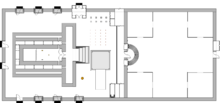
Diagram of the Temple (meridian of diagram is due north)
Co-ordinate to the Talmud, the Women'south Court was to the east and the main area of the Temple to the west.[36] The main area independent the butchering area for the sacrifices and the Outer Chantry on which portions of about offerings were burned. An edifice contained the ulam (antechamber), the hekhal (the "sanctuary"), and the Holy of Holies. The sanctuary and the Holy of Holies were separated by a wall in the First Temple and by two curtains in the Second Temple. The sanctuary contained the seven branched candlestick, the tabular array of showbread and the Incense Altar.
The main courtyard had 13 gates. On the southward side, start with the southwest corner, in that location were four gates:
- Shaar Ha'Elyon (the Upper Gate)
- Shaar HaDelek (the Kindling Gate), where forest was brought in
- Shaar HaBechorot (the Gate of Firstborns), where people with first-built-in animal offerings entered
- Shaar HaMayim (the Water Gate), where the Water Libation entered on Sukkot/the Feast of Tabernacles
On the due north side, outset with the northwest corner, there were four gates:
- Shaar Yechonyah (The Gate of Jeconiah), where kings of the Davidic line enter and Jeconiah left for the last time to captivity after being dethroned past the King of Babylon
- Shaar HaKorban (The gate of the Offering), where priests entered with kodshei kodashim offerings
- Shaar HaNashim (The Women's Gate), where women entered into the Azara or main courtyard to perform offerings[37]
- Shaar Hashir (The Gate of Song), where the Levites entered with their musical instruments
The Hall of Hewn Stones (Hebrew: לשכת הגזית Lishkat haGazit), as well known equally the Chamber of Hewn Rock, was the meeting identify, or council-sleeping accommodation, of the Sanhedrin during the Second Temple period (sixth century BCE – 1st century CE). The Talmud deduces that it was built into the north wall of the Temple in Jerusalem, half within the sanctuary and half exterior, with doors providing access both to the temple and to the outside. The chamber is said to have resembled a basilica in appearance,[38] having two entrances: one in the e and one in the w.[39]
On the east side was Shaar Nikanor, betwixt the Women's Courtyard and the primary Temple Courtyard, which had 2 minor doorways, one on its correct and one on its left. On the western wall, which was relatively unimportant, in that location were ii gates that did non have whatsoever name.
The Mishnah lists concentric circles of holiness surrounding the Temple: Holy of Holies; Sanctuary; Anteroom; Court of the Priests; Court of the Israelites; Court of the Women; Temple Mount; the walled city of Jerusalem; all the walled cities of the Land of Israel; and the borders of the Land of Israel.
Temple services [edit]

The Temple was the place where offerings described in the form of the Hebrew Bible were carried out, including daily morn and afternoon offerings and special offerings on Sabbath and Jewish holidays. Levites recited Psalms at advisable moments during the offerings, including the Psalm of the Day, special psalms for the new month, and other occasions, the Hallel during major Jewish holidays, and psalms for special sacrifices such as the "Psalm for the Thanksgiving Offer" (Psalm 100).
Equally role of the daily offer, a prayer service was performed in the Temple which was used as the basis of the traditional Jewish (morning) service recited to this day, including well-known prayers such as the Shema, and the Priestly Blessing. The Mishna describes it as follows:
The superintendent said to them, bless 1 benediction! and they blessed, and read the 10 Commandments, and the Shema, "And it shall come to pass if you will hearken", and "And [God] spoke...". They pronounced three benedictions with the people nowadays: "True and firm", and the "Avodah" "Accept, Lord our God, the service of your people State of israel, and the fire-offerings of State of israel and their prayer receive with favor. Blessed is He who receives the service of His people Israel with favor" (similar to what is today the 17th blessing of the Amidah), and the Priestly Approval, and on the Sabbath they recited one blessing; "May He who causes His name to dwell in this Business firm, cause to dwell among you beloved and brotherliness, peace and friendship" on behalf of the weekly Priestly Guard that departed.
In the Talmud [edit]
Seder Kodashim, the fifth order, or division, of the Mishnah (compiled between 200 and 220 CE), provides detailed descriptions and discussions of the religious laws connected with Temple service including the sacrifices, the Temple and its furnishings, also as the priests who carried out the duties and ceremonies of its service. Tractates of the order deal with the sacrifices of animals, birds, and repast offerings, the laws of bringing a sacrifice, such as the sin offering and the guilt offering, and the laws of misappropriation of sacred property. In addition, the order contains a description of the Second Temple (tractate Middot), and a description and rules about the daily sacrifice service in the Temple (tractate Tamid).[40] [41] [42]
In the Babylonian Talmud, all the tractates have Gemara – rabbinical commentary and analysis – for all their chapters; some chapters of Tamid, and none on Middot and Kinnim. The Jerusalem Talmud has no Gemara on any of the tractates of Kodashim.[41] [42]
The Talmud (Yoma 9b) describes traditional theological reasons for the devastation: "Why was the outset Temple destroyed? Because the 3 fundamental sins were rampant in order: idol worship, licentiousness, and murder… And why so was the 2d Temple – wherein the gild was involved in Torah, commandments and acts of kindness – destroyed? Considering complimentary hatred was rampant in lodge."[43] [44]
Role in contemporary Jewish services [edit]
Role of the traditional Jewish morning service, the part surrounding the Shema prayer, is essentially unchanged from the daily worship service performed in the Temple. In addition, the Amidah prayer traditionally replaces the Temple's daily tamid and special-occasion Mussaf (additional) offerings (there are dissever versions for the unlike types of sacrifices). They are recited during the times their corresponding offerings were performed in the Temple.
The Temple is mentioned extensively in Orthodox services. Bourgeois Judaism retains mentions of the Temple and its restoration, just removes references to the sacrifices. References to sacrifices on holidays are made in the by tense, and petitions for their restoration are removed. Mentions in Orthodox Jewish services include:
- A daily recital of Biblical and Talmudic passages related to the korbanot (sacrifices) performed in the Temple (See korbanot in siddur).
- References to the restoration of the Temple and sacrificial worships in the daily Amidah prayer, the central prayer in Judaism.
- A traditional personal plea for the restoration of the Temple at the end of private recitation of the Amidah.
- A prayer for the restoration of the "house of our lives" and the shekhinah (divine presence) "to dwell among usa" is recited during the Amidah prayer.
- Recitation of the Psalm of the day; the psalm sung past the Levites in the Temple for that day during the daily morning service.
- Numerous psalms sung as office of the ordinary service make all-encompassing references to the Temple and Temple worship.
- Recitation of the special Jewish vacation prayers for the restoration of the Temple and their offering, during the Mussaf services on Jewish holidays.
- An all-encompassing recitation of the special Temple service for Yom Kippur during the service for that vacation.
- Special services for Sukkot (Hakafot) incorporate extensive (but generally obscure) references to the special Temple service performed on that twenty-four hour period.
The devastation of the Temple is mourned on the Jewish fast day of Tisha B'Av. Three other minor fasts (10th of Tevet, 17th of Tammuz, and Tertiary of Tishrei), as well mourn events leading to or following the destruction of the Temple. There are also mourning practices which are observed at all times, for example, the requirement to go out part of the firm unplastered.
Recent history [edit]
The Temple Mount, forth with the entire Quondam City of Jerusalem, was captured from Hashemite kingdom of jordan by Israel in 1967 during the Six-Mean solar day State of war, allowing Jews over again to visit the holy site.[45] [46] Hashemite kingdom of jordan had occupied East Jerusalem and the Temple Mountain immediately following Israel'south proclamation of independence on May fourteen, 1948. Israel officially unified Due east Jerusalem, including the Temple Mountain, with the rest of Jerusalem in 1980 nether the Jerusalem Constabulary, though Un Security Council Resolution 478 declared the Jerusalem Law to exist in violation of international police force.[ citation needed ] The Jerusalem Islamic Waqf, based in Jordan, has authoritative control of the Temple Mountain.
In other religions [edit]
Christianity [edit]
According to Matthew 24:2,[47] Jesus predicts the destruction of the 2nd Temple. This idea, of the Temple equally the body of Christ, became a rich and multi-layered theme in medieval Christian idea (where Temple/body can be the heavenly body of Christ, the ecclesial body of the Church, and the Eucharistic body on the altar).[48]
Islam [edit]
The Temple Mount bears significance in Islam every bit it acted as a sanctuary for the Hebrew prophets and the Israelites. Islamic tradition says that a temple was first congenital on the Temple Mount past Solomon, the son of David. After the destruction of the 2d temple, it was rebuilt by the second Rashidun Caliph, Omar, which stands until today equally Al-Aqsa Mosque. Traditionally referred to as the "Farthest Mosque" (al-masjid al-aqṣa' literally "utmost site of bowing (in worship)" though the term at present refers specifically to the mosque in the southern wall of the compound which today is known simply as al-haram ash-sharīf "the noble sanctuary"), the site is seen equally the destination of Muhammad'southward Night Journey, one of the most pregnant events recounted in the Quran and the place of his ascent heavenwards thereafter (Mi'raj). Muslims view the Temple in Jerusalem as their inheritance, existence the followers of the last prophet of God and believers in every prophet sent, including the prophets Moses and Solomon. To Muslims, Al-Aqsa Mosque is non built on meridian of the temple, rather, it is the Tertiary Temple, and they are the true believers who worship in it, whereas Jews and Christians are disbelievers who do non believe in God'due south final prophets Jesus and Muhammad.[49] [50]
In Islam, Muslims are encouraged to visit Jerusalem and pray at Al-Aqsa Mosque. There are over forty hadith nearly Al-Aqsa Mosque and the virtue of visiting and praying in it, or at least sending oil to calorie-free its lamps. In a hadith compiled by Al-Tabarani, Bayhaqi, and Suyuti, the Prophet Muhammad said, "A prayer in Makkah (Ka'bah) is worth 1000,000 times (reward), a prayer in my mosque (Madinah) is worth 1,000 times and a prayer in Al-Aqsa Sanctuary is worth 500 times more reward than anywhere else." Another hadith compiled past imams Muhammad al-Bukhari, Muslim, and Abu Dawud expounds on the importance of visiting the holy site. In another hadith the prophet Muhammad said, "You should non undertake a special journey to visit any identify other than the following iii Masjids with the expectations of getting greater reward: the Sacred Masjid of Makkah (Ka'bah), this Masjid of mine (the Prophet's Masjid in Madinah), and Masjid Al-Aqsa (of Jerusalem)."[51]
According to Seyyed Hossein Nasr, professor of Islamic Studies at George Washington University, Jerusalem (i.e., the Temple Mount) has the significance every bit a holy site/sanctuary ("haram") for Muslims primarily in three ways, the get-go two existence connected to the Temple.[52] First, Muhammad (and his companions) prayed facing the Temple in Jerusalem (referred to equally "Bayt Al-Maqdis", in the Hadiths) similar to the Jews earlier irresolute information technology to the Kaaba in Mecca sixteen months after arriving in Medina following the verses revealed (Sura 2:144, 149–150). Secondly, during the Meccan part of his life, he reported to have been to Jerusalem by dark and prayed in the Temple, as the offset part of his otherworldly journey (Isra and Mi'raj).
Imam Abdul Hadi Palazzi, leader of Italian Muslim Assembly, quotes the Quran to support Judaism's special connection to the Temple Mount. Co-ordinate to Palazzi, "The nigh authoritative Islamic sources affirm the Temples". He adds that Jerusalem is sacred to Muslims because of its prior holiness to Jews and its continuing as dwelling house to the biblical prophets and kings David and Solomon, all of whom he says are sacred figures in Islam. He claims that the Quran "expressly recognizes that Jerusalem plays the same role for Jews that Mecca has for Muslims".[53]
Building a Third Temple [edit]

Always since the 2d Temple'due south destruction, a prayer for the construction of a Third Temple has been a formal and mandatory office of the thrice-daily Jewish prayer services. However, the question of whether and when to construct the Tertiary Temple is disputed both inside the Jewish community and without; groups within Judaism fence both for and against construction of a new Temple, while the expansion of Abrahamic religion since the 1st century CE has fabricated the issue contentious within Christian and Islamic thought as well. Furthermore, the complicated political status of Jerusalem makes reconstruction difficult, while Al-Aqsa Mosque and the Dome of the Stone have been constructed at the traditional physical location of the Temple.
In 363 CE, the Roman emperor Julian had ordered Alypius of Antioch to rebuild the Temple as part of his entrada to strengthen non-Christian religions.[54] The endeavour failed, perhaps due to sabotage, an accidental burn, or an earthquake in Galilee.
The Book of Ezekiel prophesies what would be the Third Temple, noting it equally an eternal house of prayer and describing it in detail.
In media [edit]
A journalistic depiction of the controversies effectually the Jerusalem Temple was presented in the 2010 documentary Lost Temple past Serge Grankin. The film contains interviews with religious and academic authorities involved in the issue. German journalist Dirk-Martin Heinzelmann, featured in the picture, presents the bespeak of view of Prof. Joseph Patrich (the Hebrew Academy), stemming from the underground cistern mapping made by Charles William Wilson (1836–1905).[55]
See likewise [edit]
- Jewish Temple at Elephantine (seventh? sixth? – mid-fourth century BCE)
- Jewish Temple of Leontopolis (c. 170 BCE – 73 CE)
- Temple of Solomon (São Paulo), a replica built past a Brazil-based church building
- Synagogue
- TempleOS, lightweight operating system (OS) designed to be the Third Temple
- Like Atomic number 26 Age temples from the region
- 'Ain Dara temple[56]
- Ebla (Temple D)[56]
- Emar temple[56]
- Mumbaqat temple[56]
- Tell Tayinat temple (8th century BCE)[56]
Notes [edit]
- ^ Lit. "holy of holies"
- ^ The historian Josephus echoes this same theme, when he writes The Jewish War five.5.2. (v.193–194): "When one gain through the cloisters to the 2nd court of the temple, in that location was a stone partition all round, whose height was 3 cubits and of most elegant construction. Upon information technology stood pillars, at equal distances from one another, declaring the police force of purity, some in Greek and some in Roman messages, that 'no foreigner should go within the Holy Place,' for that 2d [court of the] temple was chosen 'the Holy Place,' and was ascended to past 14 steps from the first courtroom."
- ^ New American Oxford Dictionary: "Temple".
References [edit]
- ^ Exodus 25:8
- ^ 1 Chronicles 22:11
- ^ "The Jewish Temple (Beit HaMikdash)". www.jewishvirtuallibrary.org . Retrieved 2018-01-23 .
- ^ G.A. Williamson, ed. (1980). Josephus - The Jewish War. Middlesex, U.K.: The Penguin Classics. p. 290 (note two). OCLC 633813720.
Throughout this translation 'Sanctuary' represents Greek naos and denotes the central shrine, while 'Temple' represents hieron and includes the courts, colonnades, etc. surrounding the shrine.
(OCLC 1170073907) (reprint) - ^ Exodus 39:40
- ^ Maimonides (1974). Sefer Mishneh Torah - HaYad Ha-Chazakah (Maimonides' Lawmaking of Jewish Law) (in Hebrew). Vol. 4. Jerusalem: Pe'er HaTorah. , south.v. Hil. Beit Ha-Bechirah 1:5
- ^ a b "Temple, the." Cross, F. L., ed. The Oxford Dictionary of the Christian Church. New York: Oxford University Press. 2005
- ^ "Temple of Jerusalem | Description, History, & Significance". Encyclopedia Britannica . Retrieved 2020-x-26 .
- ^ Deuteronomy 12:2–27
- ^ Durant, Will. Our Oriental Heritage. New York: Simon and Schuster. 1954. p. 307. Run into one Kings 3:two.
- ^ Oxford History of Ancient Egypt, p, 335, Oxford 2000
- ^ Shalem, Yisrael (1997). "2d Temple Menstruum (538 B.C.East. to 70 C.E.): Western farsi Dominion". Jerusalem: Life Throughout the Ages in a Holy City. Ramat-Gan, State of israel: Ingeborg Rennert Center for Jerusalem Studies, Bar-Ilan Academy. Retrieved 8 January 2020.
- ^ Waters, Matt (2014). Ancient Persia: A Concise History of the Achaemenid Empire, 550–330 BCE. Cambridge University Press. p. 212. ISBN978-i-107-00960-8 . Retrieved 8 January 2020.
- ^ Ezra iii:8–x
- ^ Jamieson, Robert; Fausset, A. R.; Dark-brown, David (1882). "Ezra 6:13–15. The Temple Finished". A Commentary, Critical, Practical, and Explanatory on the Old and New Testaments . Retrieved viii January 2020 – via BibleHub.com.
- ^ Edelman, Diana (2014). "The Seventy-Yr Tradition Revisited". The Origins of the '2nd' Temple: Persion Imperial Policy and the Rebuilding of Jerusalem (reprint, revised ed.). Routledge. pp. 103–104. ISBN978-1-84553-016-7 . Retrieved viii January 2020.
- ^ 'Abdu'l-Baha (ed.). Some Answered Questions . Retrieved 10 December 2016.
- ^ "Shimon HaTzaddik". Orthodox Marriage. 14 June 2006.
- ^ Josephus, The New Complete Works, translated by William Whiston, Kregel Publications, 1999, "Antiquites" Book 14:iv, p.459-460
- ^ Michael Grant, The Jews in the Roman Earth, Barnes & Noble, 1973, p.54
- ^ Peter Richardson, Herod: King of the Jews and Friend of the Romans, Univ. of Due south Carolina Printing, 1996, p.98-99
- ^ Josephus, The New Complete Works, translated by William Whiston, Kregel Publications, 1999, "Antiquites" Volume fourteen:7, p.463
- ^ Michael Grant, The Jews in the Roman Earth, Barnes & Noble, 1973, p.58
- ^ "Were at that place Jewish Temples on Temple Mount? Yep – Israel News". Haaretz . Retrieved 2016-08-fifteen .
- ^ "Were There Jewish Temples on Temple Mount? Yes". Haaretz . Retrieved 2022-01-11 .
- ^ Harry H. Moskoff. (10 February 2022). "Is there new show of Jewish Temple treasures in the Vatican?". Jerusalem Post website Retrieved 14 February 2022.
- ^ See commodity in the Earth Jewish Digest, April 2007
- ^ "Berakhot 54a:7".
- ^ "Yoma 54b:2".
- ^ "Sanhedrin 26b:5".
- ^ Jeremiah xix:fourteen; 26:two
- ^ 1 Kings 6:36
- ^ ii Chr. iv:nine
- ^ 2 Chr. iii:five
- ^ 1 Kings 6:17
- ^ Mishna Tractate Midos.
- ^ Sheyibaneh Beit Hamikdash: Women in the Azara? Archived 2006-07-29 at the Wayback Automobile
- ^ Babylonian Talmud (Yoma 25a)
- ^ Mishnah Taharoth 6:viii, Commentary of Rabbi Hai Gaon, due south.v. בסילקי
- ^ Birnbaum, Philip (1975). "Kodashim". A Book of Jewish Concepts. New York, NY: Hebrew Publishing Visitor. pp. 541–542. ISBN088482876X.
- ^ a b Epstein, Isidore, ed. (1948). "Introduction to Seder Kodashim". The Babylonian Talmud. Vol. 5. Singer, One thousand.H. (translator). London: The Soncino Printing. pp. xvii–xxi.
- ^ a b Arzi, Abraham (1978). "Kodashim". Encyclopedia Judaica. Vol. 10 (1st ed.). Jerusalem, Israel: Keter Publishing House Ltd. pp. 1126–1127.
- ^ "Gratuitous Hatred – What is it and Why is it so bad?" (PDF).
- ^ "Hatred".
- ^ "The Liberation of the Temple Mount and Western Wall (June 1967)". www.jewishvirtuallibrary.org . Retrieved 2017-03-29 .
- ^ "1967: Reunification of Jerusalem". world wide web.sixdaywar.org . Retrieved 2017-03-29 .
- ^ Matthew 24:two
- ^ See Jennifer A. Harris, "The Body as Temple in the Loftier Middle Ages", in Albert I. Baumgarten ed., Sacrifice in Religious Experience, Leiden, 2002, pp. 233–256.
- ^ Anderson, James (2018). "The Axis of Covenant Theology to the Islamic Faith" (PDF). Reformed Theological Seminary . Retrieved nineteen May 2021.
- ^ Carr, Gregory (2020-03-18). "A Cursory History of the Temple of Jerusalem". Halaqa . Retrieved 19 May 2021.
- ^ "Masjid Al Aqsa: The Best Place of Residence - 40 Ahadith". Sabeel Travels . Retrieved 19 May 2021.
- ^ "The Spiritual Significance of Jerusalem: The Islamic Vision. The Islamic Quarterly. iv (1998): pp.233–242
- ^ Margolis, David (February 23, 2001). "The Muslim Zionist". Los Angeles Jewish Periodical.
- ^ Ammianus Marcellinus, Res Gestae, 23.1.2–three.
- ^ "Lost Temple". 1 Jan 2000 – via IMDb.
- ^ a b c d e Monson, John M. (June 1999). "The Temple of Solomon: Middle of Jerusalem". In Hess, Richard S.; Wenham, Gordon J. (eds.). Zion, city of our God. C.The Ain Dara Temple:A New Parallel from Syria. Wm. B. Eerdmans Publishing. pp. 12–19. ISBN978-0-8028-4426-2 . Retrieved xv Feb 2011.
Farther reading [edit]
- Biblical Archæology Review, issues: July/August 1983, November/December 1989, March/April 1992, July/August 1999, September/Oct 1999, March/April 2000, September/October 2005
- Ritmeyer, Leen. The Quest: Revealing the Temple Mountain in Jerusalem. Jerusalem: Carta, 2006. ISBN 965-220-628-8
- Hamblin, William and David Seely, Solomon's Temple: Myth and History (Thames and Hudson, 2007) ISBN 0-500-25133-ix
- Yaron Eliav, God's Mountain: The Temple Mountain in Time, Place and Memory (Baltimore: Johns Hopkins University Press, 2005)
- Rachel Elior, The Jerusalem Temple: The Representation of the Imperceptible, Studies in Spirituality 11 (2001), pp. 126–143
External links [edit]
- Visit of the Temple Institute Museum in Jerusalem conducted by Rav Israel Ariel
- Video tour of a model of the future temple described in Ezekiel chapters 40–49 from a Christian perspective Archived 2008-05-29 at the Wayback Machine
- Rachel Elior, "The Jerusalem Temple – The Representation of the Ephemeral", Studies in Spirituality eleven (2001): 126–143
- The Centrality of Covenant Theology to the Islamic Faith
- A Brief History of the Temple of Jerusalem
Coordinates: 31°46′40″Due north 35°14′08″E / 31.77765°Due north 35.23547°Eastward / 31.77765; 35.23547

What Time Services Starts Holy Temple Monroe La,
Source: https://en.wikipedia.org/wiki/Temple_in_Jerusalem
Posted by: bushcraight.blogspot.com
0 Response to "What Time Services Starts Holy Temple Monroe La"
Post a Comment