

Can I Get An Israeli Hearing Aid Serviced In America
An air-raid siren awakened Erez Lugashi one nighttime in 2014. Every bit he ran for shelter, he wondered: What would a deafened person doin this situation?
That question led the experienced Tel Aviv entrepreneur to first Abilisense. The thought was to develop software for IoT devices, such every bit smart watches, that sends vibrating or visual alerts to hearing-impaired individuals nigh anything from an air-raid siren to a crying baby.
Abilisense was incubated at the A3i Israeli accelerator for assistive technologies. The startup won Israeli government and Microsoft grants for developing products for deaf people.
And while Herzliya-based Abilisense is expanding into general security and rubber applications as it gets closer to commercialization, the original goal of helping the deafened remains of import to Lugashi.
Hearing loss is estimated to affect more than 400 meg people effectually the world.
"Accessibility has extended beyond the concrete to how to give services to persons with disabilities. For someone hearing impaired, a wider doorway that fits a wheelchair is irrelevant. What's important is making communication accessible," says Yuval Wagner, founder and president of the nonprofit system Access Israel.
"The futurity is all about making sure that all technology is fully accessible so that people with vision or hearing disabilities can accomplish daily tasks independently," he says.
Wagner besides notes that technologies originally developed for people with disabilities frequently find their way into the full general market – as happened with Abilisense.
Let'southward look at several other Israeli solutions for people with hearing harm.
Tunefork
Tomer Shor and Yoav Blau, veterans of the famed 8200 IDF signal intelligence and code decryption unit, founded Tunefork two years agone. At that place's a personal connectedness: Shor's father and Blau's wife both have severe hearing loss.
Tunefork's personalized audio profiles can exist integrated into smart devices to improve each user's digital audio experience – phone calls, music, movies, audio books, GPS directions and more. The technology can be used with or without hearing aids.
"Each of u.s.a. has a unique 'earprint,' like a fingerprint," explains Shor, "so assistive technology needs to be personalized."
Tunefork users create their audio contour via a quick smartphone-based hearing test. The profile can and then be matched precisely to technical data held on whatever registered sound equipment, headphones, earbuds and mobile devices to all-time compensate for the user's hearing loss.
"Our demo application has ten,000 users so far in Israel and the US, mostly music apps," say Shor. "We're starting proofs of concept with large manufacturers all over the world."
Tunefork has won dozens of prizes in international and local startup competitions and attracted investors in Israel, Europe and the United States. The startup has seven employees at offices in Tel Aviv and Jerusalem.
GalaPro
The GalaPro app for iOS and Android makes live entertainment accessible and inclusive past delivering automated multilingual subtitles, closed captioning, dubbing, amplification and sound description (for people with visual disabilities) to the user's own mobile device.
Founded in 2015 with offices in Tel Aviv and New York, GalaPro has partnered with Broadway theaters, concert halls, opera houses, film festivals, exhibitions, museums and more. The app too provides content on demand.
The app works in existent time for every performance at every partner venue, in any seat, and doesn't disturb surrounding audition members.
Many people without hearing or vision disabilities use GalaPro every bit a simultaneous translation solution (retrieve Kabuki theater in Japan or opera in Italy) or to better follow dialogue via airtight captions.
Hearing at your fingertips
Sensory commutation devices (SSDs) are the specialty of Hebrew University medical neurobiologist Amir Amedi.
His world-renowned Lab for Brain and Multisensory Inquiry mainly focuses on enabling people with vision impairment to "see" their environment through sound and touch on.
Recently, Amedi's lab collaborated with the World Hearing Centre in Warsaw on a novel inexpensive and noninvasive spoken language-to-touch SSD that could improve hearing comprehension for people with cochlear implants.
Their proof-of-concept report, published in Restorative Neurology and Neuroscience, explains that people with cochlear implants "however encounter significant practical and social challenges," especially agreement speech in noisy environments.
Amedi and colleagues designed a minimalistic SSD that transforms depression-frequency speech signals into tactile vibrations delivered on two fingertips. The vibration conveys a set of "fundamental frequencies" that characterize speech signals.
In the study, participants as a group demonstrated a significant half dozen-decibel comeback and did not need special training to use the SSD.
The ability to "hear" through one's fingers has"of import implications for farther research, likewise as possible clinical and practical solutions," said co-author Tomasz Wolak, head of the Bio imaging Research Center at the Globe Hearing Centre.
The team aims to further improve the device to accomplish the goal of x-decibel enhancement. They also programme to written report human being brain mechanisms using an MRI-uniform version of the device in both hearing and hearing-dumb subjects.
Map of the inner ear
A recently published paper from the lab of Prof. Karen Avraham at Tel Aviv University'due south medical schoolhouse says that more than 100 genes have been found to be linked to genetic deafness.
This new understanding, based on the Human Genome Projection, could help scientists notice biological treatments for genetic hearing loss.
"Current treatments rely on distension or prosthetics," according to Avraham."Gene therapy would intuitively be ideal for these conditions since it is directed at the very source of the problem."
Last year, Avraham led an Israeli, American and Italian study that mapped, for the kickoff time, genetic signals in the mammalian inner ear (cochlea).
Inside the inner ear, tiny pilus cells turn soundwaves into electrical pulses that are transmitted via the auditory nerve to the encephalon. Nonworking hair cells tin can't be "turned on."
However, other cells in the inner ear perchance could be coaxed into becoming functional hair cells.
The map of genetic signals in the inner ear is essential to such an approach.
I of these signals is methylation, a chemical procedure that gives genes "orders" for differentiating cell types. Discovered by Hebrew University researchers Howard (Chaim) Cedar and Aharon Razin, methylation explains why, for example, ane cell turns into a nervus prison cell and some other grows into a pare prison cell.
Manipulating methylation and other signals "would allow us to transform cells in the inner ear to become or create new ones to permit for proper hearing," said Avraham.
"Our assay of the DNA methylation dynamics revealed a big number of new genes that are critical for the development of the inner ear and the onset of hearing itself," she said. "We hope that our epigenetic maps of the inner ear will provide entry points into the development of therapeutics for hearing loss."
Lipifai
Speech-to-text technology is not a perfect solution, especially when there's ambient noise.
Julie Dai of Haifa and Waseem Ghrayeb of Nazareth intend their Lipifai artificially intelligent online lip-reading technology to overcome that trouble.
Non however commercialized, Lipifai not just "listens" to the speaker via the telephone's microphone. Information technology also "watches" the speaker'southward lips via the phone's camera.
In depression-noise environments, both inputs feed the resulting text displayed on the screen.
If there's a lot of noise – like in a eating place — the app switches only to the lip-reading component. And whereas man lip-readers average upwardly to twoscore% accuracy, Lipifai boosts accurateness to more than than 85%, Ghrayeb tells ISRAEL21c.
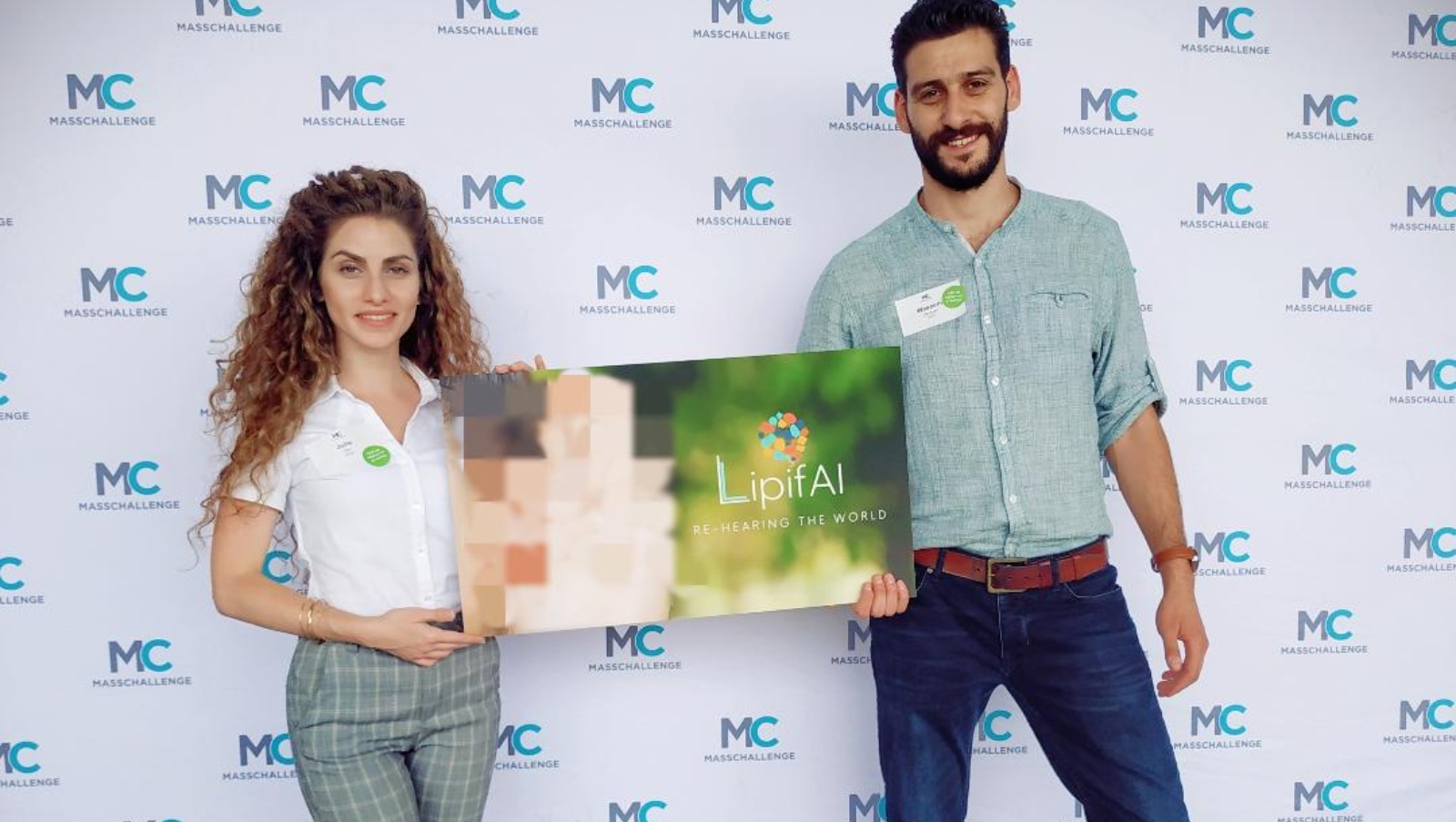
Julie Dai and Waseem Ghrayeb, developers of online lip-reading technology LipifAI. Photograph: courtesy
Dai and Ghrayeb both worked for nine years in the high-tech industry; Dai has a principal's caste in computer science and Ghrayeb has a principal's in bogus intelligence.
They began developing their solution as fellows in the 2019 cohort of Our Generation Speaks, a program at Brandeis Academy in Massachusetts that pairs budding entrepreneurs from State of israel'southward Jewish and Arab sectors. OGS also invested in Lipifai.
Last summer, Dai and Ghrayeb took Lipifai to the Massachusetts Found of Technology for farther development at entrepreneurship accelerator MIT:designX and MISTI, MIT's international education program. Several MIT interns will come to Haifa in January to continue working with them on evolution.

Can I Get An Israeli Hearing Aid Serviced In America,
Source: https://www.israel21c.org/how-israelis-are-going-to-help-us-hear-better/
Posted by: bushcraight.blogspot.com
0 Response to "Can I Get An Israeli Hearing Aid Serviced In America"
Post a Comment