

Who Consumes Goods And Services In Canada
 Toronto, the financial centre of Canada | |
| Currency | Canadian dollar (CAD, C$) |
|---|---|
| Fiscal year | Apr 1 – March 29 |
| Trade organizations | OECD, WTO and others |
| Country group |
|
| Statistics | |
| Population |  38,526,760 (Q1, 2022)[3] 38,526,760 (Q1, 2022)[3] |
| Gdp |
|
| Gross domestic product rank |
|
| GDP growth |
|
| GDP per capita |
|
| GDP per capita rank |
|
| GDP by sector |
|
| Inflation (CPI) |  5.1% (12 calendar month alter - January 2022)[6] 5.1% (12 calendar month alter - January 2022)[6] |
| Population below poverty line |  6.4% (official, 2020; StatCan)[7] 6.4% (official, 2020; StatCan)[7] |
| Gini coefficient | 0.281 low (2020, StatCan)[8] [ix] |
| Homo Development Index |
|
| Labour force |
|
| Unemployment |
|
| Average gross salary | $1,042 weekly (September 2019)[15] |
| Master industries |
|
| Ease-of-doing-business rank |  23rd (very easy, 2020)[16] 23rd (very easy, 2020)[16] |
| External | |
| Exports | $631.iii billion (2021)[17] |
| Consign appurtenances | motor vehicles and parts, industrial machinery, aircraft, telecommunications equipment; chemicals, plastics, fertilizers; wood pulp, timber, rough petroleum, natural gas, electricity, aluminum |
| Master export partners |
|
| Imports | $613.half dozen billion (2021)[19] |
| Import goods | machinery and equipment, motor vehicles and parts, crude oil, chemicals, electricity, durable consumer goods |
| Principal import partners |
|
| FDI stock |
|
| Current account | $1.4 billion (Q3 2021)[21] |
| Gross external debt | $iii.251 trillion (Q3 2021)[22] |
| Public finances | |
| Public debt | 133.32% of GDP (2021 est.)[5] [notation 1] [23] |
| Upkeep residue | −i% (of Gdp) (2017 est.)[5] |
| Revenues | 649.6 billion (2017 est.)[5] |
| Expenses | 665.7 billion (2017 est.)[5] |
| Economical aid | donor: ODA, $3.96 billion (2016)[24] |
| Credit rating |
|
| Foreign reserves | $86.three billion (June 2019)[28] [29] |
| Main data source: CIA World Fact Book | |


Historical Gdp per capita of Canada
The economy of Canada is a highly developed mixed-market economy.[thirty] [31] It is the 8th largest Gross domestic product by nominal and 15th largest GDP past PPP in the earth. As with other developed nations, the country's economy is dominated by the service industry which employs about three quarters of Canadians.[32] Canada has the tertiary-highest total estimated value of natural resources, valued at Int$33.98 trillion in 2019`.[33] It has the world'due south third largest proven oil reserves and is the fourth largest exporter of crude oil. Information technology is also the 5th largest exporter of natural gas.
Co-ordinate to the Abuse Perceptions Alphabetize, Canada is perceived as one of the least corrupt countries in the earth,[34] and is one of the world's top ten trading nations, with a highly globalized economy.[35] [36] Canada historically ranks above the The states and most western European nations on The Heritage Foundation's alphabetize of economic freedom,[37] while experiencing a relatively low level of income disparity.[38] The country's average household disposable income per capita is "well above" the OECD average.[39] The Toronto Stock Substitution is the eighth-largest stock substitution in the world by market capitalization, list over 1,500 companies with a combined market place capitalization of over The states$iii trillion.[twoscore]
In 2021, Canadian merchandise in goods and services reached CA$2.016 trillion.[41] Canada's exports totalled over CA$637 billion, while its imported goods were worth over CA$631 billion, of which approximately CA$391 billion originated from the United States, CA$216 billion from non-U.South. sources.[41] In 2018, Canada had a trade deficit in goods of CA$22 billion and a trade arrears in services of CA$25 billion.[41]
Canada is unusual among developed countries in the importance of the master sector, with the logging and energy industries being 2 of Canada's most important. Canada besides has a sizable manufacturing sector, based in Central Canada, with the automobile industry and shipping industry being especially important. With the globe'south longest coastline, Canada has the 8th largest commercial line-fishing and seafood industry in the earth.[42] [43] Canada is i of the global leaders of the entertainment software industry.[44] It is a fellow member of the APEC, G7, G20, OECD and WTO, and was formerly a member of NAFTA until the USMCA came into force in 2020. In Canada, the USMCA is officially known as the Canada–United States–Mexico Understanding (CUSMA) in English language and the Accord Canada–États-Unis–Mexique (ACEUM) in French.
Overview [edit]
With the exception of a few island nations in the Caribbean, Canada is the only major Northward American country to apply the parliamentary system of regime. As a result, Canada has developed its ain social and political institutions, distinct from near other countries in the world.[45] Though the Canadian economy is closely integrated with the American economy, it has developed unique economic institutions.
The Canadian economic system generally combines elements of private enterprise and public enterprise. Many aspects of public enterprise, almost notably the development of an extensive social welfare system to redress social and economic inequities, were adopted subsequently the end of Earth War 2 in 1945.[45]
Approximately 89% of Canada'south state is Crown land.[46] Canada has one of the highest levels of economical liberty in the world. Today Canada closely resembles the U.Southward. in its market-oriented economic system and pattern of production.[47] As of 2019, Canada has 56 companies in the Forbes Global 2000 list, ranking 9th just behind South Korea and ahead of Saudi arabia.[48]
International trade makes upwardly a large part of the Canadian economy, particularly of its natural resources. In 2009, agriculture, energy, forestry and mining exports deemed for about 58% of Canada'due south total exports.[49] Machinery, equipment, automotive products and other manufactures accounted for a further 38% of exports in 2009.[49] In 2009, exports deemed for virtually 30% of Canada'southward Gdp. The Us is past far its largest trading partner, accounting for well-nigh 73% of exports and 63% of imports as of 2009.[l] Canada's combined exports and imports ranked 8th among all nations in 2006.[51]
Most 4% of Canadians are directly employed in primary resources fields, and they account for 6.2% of GDP.[52] They are withal paramount in many parts of the state. Many, if non almost, towns in northern Canada, where agriculture is hard, be because of a nearby mine or source of timber. Canada is a earth leader in the product of many natural resources such equally gold, nickel, uranium, diamonds, lead, and in recent years, crude petroleum, which, with the world'south second-largest oil reserves, is taking an increasingly prominent position in natural resources extraction. Several of Canada'southward largest companies are based in natural resource industries, such as Encana, Cameco, Goldcorp, and Barrick Aureate. The vast bulk of these products are exported, mainly to the United states. There are as well many secondary and service industries that are straight linked to primary ones. For instance i of Canada's largest manufacturing industries is the pulp and paper sector, which is direct linked to the logging business.
The reliance on natural resources has several effects on the Canadian economic system and Canadian order. While manufacturing and service industries are piece of cake to standardize, natural resources vary greatly by region. This ensures that differing economic structures developed in each region of Canada, contributing to Canada's strong regionalism. At the same time the vast majority of these resources are exported, integrating Canada closely into the international economy. Howlett and Ramesh debate that the inherent instability of such industries also contributes to greater government intervention in the economy, to reduce the social touch on of market changes.[53]
Natural resource industries also heighten important questions of sustainability. Despite many decades as a leading producer, there is picayune adventure of depletion. Big discoveries continue to be fabricated, such every bit the massive nickel observe at Voisey'due south Bay. Moreover, the far north remains largely undeveloped as producers await higher prices or new technologies as many operations in this region are not yet toll effective. In recent decades Canadians have become less willing to accept the environmental destruction associated with exploiting natural resources. High wages and Ancient land claims have too curbed expansion. Instead, many Canadian companies have focused their exploration, exploitation and expansion activities overseas where prices are lower and governments more amenable. Canadian companies are increasingly playing important roles in Latin America, Southeast Asia, and Africa.
The depletion of renewable resources has raised concerns in recent years. After decades of escalating overutilization the cod fishery all simply collapsed in the 1990s, and the Pacific salmon industry as well suffered profoundly. The logging industry, later many years of activism, has in recent years moved to a more sustainable model, or to other countries.
Information [edit]
The following tabular array shows the chief economic indicators in 1980–2020 (with IMF staff estimates for 2021–2026). Inflation below 3% is in green.[54]
| Year | GDP (in Bil. The states$PPP) | GDP per capita (in U.s.$ PPP) | GDP (in Bil. The states$nominal) | Gross domestic product per capita (in US$ nominal) | Gross domestic product growth (existent) | Inflation rate (in Per centum) | Unemployment (in Per centum) | Government debt (in % of Gdp) |
|---|---|---|---|---|---|---|---|---|
| 1980 | 288.7 | 11,798.2 | 276.0 | xi,280.2 | 2.2% | 10.2% | 7.5% | 44.half-dozen% |
| 1981 | 327.1 | thirteen,197.5 | 307.two | 12,396.vii | 3.5% | 12.v% | vii.6% | 46.one% |
| 1982 | 336.2 | 13,404.ix | 314.6 | 12,543.9 | -3.two% | 10.8% | 11.one% | 51.seven% |
| 1983 | 358.five | 14,149.5 | 341.9 | 13,493.2 | 2.half-dozen% | 5.8% | 12.0% | 57.2% |
| 1984 | 393.4 | 15,380.2 | 356.7 | 13,947.four | 5.ix% | 4.3% | 11.4% | lx.2% |
| 1985 | 425.0 | 16,466.0 | 366.2 | 14,185.9 | 4.7% | iv.0% | 10.five% | 65.2% |
| 1986 | 442.nine | 16,990.4 | 379.0 | fourteen,539.8 | 2.1% | 4.2% | ix.6% | 69.3% |
| 1987 | 472.three | 17,893.0 | 433.one | 16,408.1 | 4.1% | four.4% | 8.8% | 69.eight% |
| 1988 | 510.6 | 19,085.3 | 509.4 | 19,041.2 | 4.4% | 4.0% | 7.8% | 69.7% |
| 1989 | 542.9 | 19,947.7 | 567.2 | 20,842.5 | 2.iii% | five.0% | 7.v% | 71.0% |
| 1990 | 564.i | xx,415.one | 596.1 | 21,572.i | 0.2% | 4.eight% | 8.2% | 73.vii% |
| 1991 | 571.0 | twenty,403.iii | 612.five | 21,885.6 | -2.one% | 5.6% | 10.3% | 81.7% |
| 1992 | 589.3 | 20,805.6 | 594.4 | 20,984.8 | 0.9% | 1.5% | 11.2% | 88.2% |
| 1993 | 619.3 | 21,615.vi | 579.1 | 20,210.v | 2.7% | 1.9% | 11.4% | 94.7% |
| 1994 | 661.0 | 22,823.eight | 579.nine | twenty,024.half-dozen | 4.5% | 0.ii% | 10.4% | 97.5% |
| 1995 | 693.0 | 23,682.4 | 605.nine | twenty,706.7 | 2.seven% | 2.one% | nine.5% | 100.1% |
| 1996 | 717.ane | 24,252.2 | 630.6 | 21,325.7 | one.6% | 1.6% | 9.6% | 100.2% |
| 1997 | 760.7 | 25,469.8 | 655.0 | 21,930.5 | 4.three% | 1.half dozen% | 9.1% | 95.three% |
| 1998 | 799.iii | 26,532.4 | 634.0 | 21,046.6 | three.ix% | 1.0% | 8.3% | 93.3% |
| 1999 | 852.four | 28,068.8 | 678.4 | 22,340.6 | 5.ii% | 1.7% | 7.6% | 89.0% |
| 2000 | 916.8 | 29,914.7 | 744.6 | 24,296.7 | 5.2% | 2.7% | 6.8% | eighty.iv% |
| 2001 | 954.2 | 30,810.5 | 739.0 | 23,859.7 | 1.viii% | ii.v% | 7.2% | 81.5% |
| 2002 | 998.4 | 31,887.8 | 760.one | 24,279.two | three.0% | 2.three% | 7.seven% | 79.6% |
| 2003 | 1,036.four | 32,794.3 | 895.6 | 28,338.7 | 1.8% | 2.8% | 7.vi% | 75.9% |
| 2004 | 1,097.1 | 34,390.0 | 1,026.five | 32,176.six | 3.1% | 1.ix% | seven.two% | 71.9% |
| 2005 | 1,167.vii | 36,260.7 | 1,173.5 | 36,439.6 | three.2% | 2.ii% | 6.viii% | 70.vi% |
| 2006 | ane,235.five | 37,980.7 | 1,319.4 | 40,558.9 | 2.6% | ii.0% | half dozen.iii% | 69.9% |
| 2007 | 1,295.2 | 39,428.two | ane,468.9 | 44,717.0 | 2.1% | ii.one% | 6.ane% | 66.9% |
| 2008 | 1,333.iii | 40,159.i | one,552.9 | 46,773.8 | one.0% | two.4% | 6.two% | 67.ix% |
| 2009 | 1,302.5 | 38,788.0 | 1,376.5 | 40,990.6 | -2.9% | 0.3% | 8.4% | 79.three% |
| 2010 | 1,358.nine | twoscore,017.half dozen | i,617.3 | 47,627.3 | 3.1% | 1.eight% | 8.ane% | 81.2% |
| 2011 | 1,430.8 | 41,716.iv | i,793.3 | 52,285.nine | 3.1% | 2.9% | 7.6% | 81.8% |
| 2012 | 1,468.1 | 42,351.1 | ane,828.four | 52,744.0 | 1.8% | 1.5% | 7.iv% | 85.4% |
| 2013 | one,554.1 | 44,360.4 | 1,846.half-dozen | 52,708.6 | 2.three% | 0.9% | 7.one% | 86.1% |
| 2014 | one,621.4 | 45,812.0 | 1,805.viii | 51,020.viii | two.ix% | 1.9% | vii.0% | 85.6% |
| 2015 | 1,594.9 | 44,702.5 | 1,556.5 | 43,626.5 | 0.7% | 1.1% | 6.9% | 91.2% |
| 2016 | 1,678.4 | 46,554.1 | 1,528.0 | 42,382.6 | ane.0% | one.iv% | 7.1% | 91.7% |
| 2017 | 1,776.ix | 48,688.1 | i,649.iii | 45,192.0 | 3.0% | 1.half-dozen% | 6.four% | 88.eight% |
| 2018 | one,863.5 | 50,361.i | 1,721.eight | 46,532.ii | 2.4% | two.3% | five.9% |  88.8% 88.8% |
| 2019 | ane,932.1 | 51,477.0 | i,741.six | 46,399.7 | 1.9% | 1.nine% | 5.7% | 86.8% |
| 2020 | 1,851.5 | 48,759.3 | i,644.0 | 43,294.8 | -5.3% | 0.7% | 9.6% | 117.v% |
| 2021 | 2,027.four | 53,089.5 | 2,016.0 | 52,791.2 | 5.7% | three.2% | seven.7% | 109.nine% |
| 2022 | ii,185.0 | 56,616.five | 2,189.8 | 56,739.eight | 4.9% | 2.6% | 5.seven% | 103.ix% |
| 2023 | 2,295.9 | 58,866.0 | ii,306.1 | 59,125.six | 2.6% | 2.0% | 4.9% | 100.2% |
| 2024 | two,384.5 | 60,504.4 | 2,413.4 | 61,237.2 | i.5% | ii.2% | 5.0% | 96.9% |
| 2025 | 2,471.1 | 62,061.vi | 2,520.one | 63,293.4 | ane.4% | 2.i% | five.0% | 93.4% |
| 2026 | 2,561.iv | 63,684.3 | ii,630.ix | 65,414.4 | 1.6% | 2.0% | 5.0% | 89.vii% |
Unemployment charge per unit [edit]
| Province | Unemployment rate per centum of labour force equally of March 2022[55] |
|---|---|
| Alberta | 6.5 |
| British Columbia | 5.one |
| Manitoba | 5.3 |
| Newfoundland and Labrador | 12.nine |
| New Brunswick | seven.7 |
| Nova Scotia | six.5 |
| Ontario | 5.3 |
| Prince Edward Island | 8.1 |
| Quebec | four.1 |
| Saskatchewan | v.0 |
| Canada (national) | v.3 |
Consign trade [edit]
Consign trade from Canada measured in United states of america dollars. In 2020, Canada exported over Usa$390 billion.[56]
| Partner | Value | Fraction |
|---|---|---|
| United States | $338.ii billion | 73.v% |
| China | $18.8 billion | 4.8% |
| Britain | $15 billion | three.8% |
| Nihon | $9.2 billion | 2.4% |
| Mexico | $4.half-dozen billion | 1.two% |
| Frg | $3.8 billion | 1.0% |
| Republic of korea | $3.v billion | 0.9% |
| France | $2.8 billion | 0.7% |
| Italy | $2.8 billion | 0.7% |
| India | $2.7 billion | 0.7% |
| Netherlands | $2.iii billion | 0.6% |
| Norway | $1.9 billion | 0.5% |
| Belgium | $1.9 billion | 0.5% |
| Brazil | $1.6 billion | 0.4% |
| Australia | $1.half dozen billion | 0.four% |
Import trade [edit]
Import trade in 2017 measured in US dollars.[57]
| Partner | Value | Fraction |
|---|---|---|
| United States | $222.0 billion | 51.3% |
| China | $54.7 billion | 12.7% |
| Mexico | $27.4 billion | 6.3% |
| Germany | $13.8 billion | 3.two% |
| Japan | $thirteen.five billion | iii.1% |
| United Kingdom | $6.9 billion | 1.6% |
| Republic of korea | $6.7 billion | 1.five% |
| Italy | $half dozen.iii billion | 1.5% |
| France | $iv.8 billion | 1.1% |
| Vietnam | $iii.9 billion | 0.nine% |
Measuring productivity [edit]
Productivity measures are central indicators of economic performance and a key source of economic growth and competitiveness. The Organisation for Economical Co-operation and Development (OECD)'s[notes one] Compendium of Productivity Indicators,[58] published annually, presents a broad overview of productivity levels and growth in member nations, highlighting central measurement issues. Information technology analyses the office of "productivity as the main commuter of economic growth and convergence" and the "contributions of labour, uppercase and MFP in driving economical growth".[58] Co-ordinate to the definition in a higher place "MFP is often interpreted as the contribution to economic growth made by factors such equally technical and organisational innovation" (OECD 2008,eleven). Measures of productivity include Gross Domestic Product (Gdp)(OECD 2008,xi) and multifactor productivity.
Multifactor productivity [edit]
Some other productivity measure out, used by the OECD, is the long-term tendency in multifactor productivity (MFP) also known as full factor productivity (TFP). This indicator assesses an economy'south "underlying productive capacity ('potential output'), itself an of import measure of the growth possibilities of economies and of inflationary pressures". MFP measures the residual growth that cannot be explained past the rate of change in the services of labour, capital and intermediate outputs, and is ofttimes interpreted every bit the contribution to economic growth made by factors such as technical and organisational innovation. (OECD 2008,11)
According to the OECD's annual economical survey of Canada in June 2012, Canada has experienced weak growth of multi-gene productivity (MFP) and has been failing further since 2002. Ane of the means MFP growth is raised is by boosting innovation and Canada'southward innovation indicators such as concern R&D and patenting rates were poor. Raising MFP growth is "needed to sustain rising living standards, particularly as the population ages".[59]
Since 2010 productivity growth has picked upward, almost entirely driven by above average multifactor productivity growth.[lx] However, productivity on the whole notwithstanding lags behind the upper half of OECD countries such as the United states.[61] Canada'south productivity is at present around the median OECD productivity, close to that of Australia. More can be done to increase productivity, such as increasing the productivity of capital through improving the capital stock to output ratio and capital quality. This could be accomplished through the liberalization of internal merchandise barriers, as suggested in the OECD's latest Canadian economic survey.[62]
Bank of Canada [edit]
The mandate of the fundamental bank—the Bank of Canada is to conduct budgetary policy that "preserves the value of money by keeping inflation low and stable".[63] [64]
Monetary Policy Report [edit]
The Bank of Canada issues its bank charge per unit announcement through its Monetary Policy Study which is released 8 times a yr.[64] The Bank of Canada, a federal crown corporation, has the responsibleness of Canada's monetary system.[65] Under the aggrandizement-targeting monetary policy that has been the cornerstone of Canada'southward budgetary and fiscal policy since the early 1990s, the Banking concern of Canada sets an aggrandizement target[64] [66] The inflation target was set at 2 per cent, which is the midpoint of an inflation range of 1 to 3 per cent. They established a set of inflation-reduction targets to keep inflation "low, stable and anticipated" and to foster "conviction in the value of money", contribute to Canada'south sustained growth, employment gains and improved standard of living.[64]
In a January nine, 2019 argument on the release of the Monetary Policy Written report, Bank of Canada Governor Stephen S. Poloz summarized major events since the October report, such every bit "negative economical consequences" of the United states of america-led trade war with People's republic of china. In response to the ongoing trade state of war "bail yields have fallen, yield curves have flattened even more than and stock markets have repriced significantly" in "global financial markets". In Canada, low oil prices will impact Canada'south "macroeconomic outlook". Canada'due south housing sector is not stabilizing as quickly as anticipated.[67]
Inflation targeting [edit]
During the menstruation that John Crow was Governor of the Bank of Canada—1987 to 1994— there was a worldwide recession and the bank rate rose to around 14% and unemployment topped 11%.[65] Although since that time inflation-targeting has been adopted by "near advanced-world key banks",[68] in 1991 it was innovative and Canada was an early adopter when the and then-Finance Minister Michael Wilson approved the Bank of Canada'southward starting time inflation-targeting in the 1991 federal budget.[68] The inflation target was set at 2 per cent.[64] Inflation is measured by the total consumer price alphabetize (CPI). In 2011 the Government of Canada and the Bank of Canada extended Canada's inflation-control target to Dec 31, 2016.[64] The Depository financial institution of Canada uses 3 unconventional instruments to accomplish the inflation target: "a conditional statement on the future path of the policy rate", quantitative easing, and credit easing.[69]
As a upshot, interest rates and inflation eventually came downward along with the value of the Canadian dollar.[65] From 1991 to 2011 the inflation-targeting regime kept "toll gains fairly reliable".[68]
Following the Fiscal crisis of 2007–08 the narrow focus of inflation-targeting as a means of providing stable growth in the Canadian economy was questioned. By 2011, the so-Banking company of Canada Governor Mark Carney argued that the fundamental banking concern'south mandate would allow for a more than flexible inflation-targeting in specific situations where he would consider taking longer "than the typical half-dozen to 8 quarters to return inflation to 2 per cent".[68]
On July 15, 2015, the Bank of Canada announced that it was lowering its target for the overnight charge per unit past another one-quarter percentage point, to 0.5 per cent[70] "to try to stimulate an economy that appears to take failed to rebound meaningfully from the oil shock woes that dragged it into decline in the commencement quarter".[71] Co-ordinate to the Bank of Canada announcement, in the first quarter of 2015, the full Consumer price index (CPI) inflation was about 1 per cent. This reflects "yr-over-year price declines for consumer energy products". Core inflation in the outset quarter of 2015 was about 2 per cent with an underlying tendency in inflation at about 1.five to 1.7 per cent.[70]
In response to the Bank of Canada's July 15, 2015 rate adjustment, Prime Minister Stephen Harper explained that the economy was "beingness dragged down by forces beyond Canadian borders such every bit global oil prices, the European debt crisis, and China's economic slowdown" which has made the global economy "frail".[72]
The Chinese stock marketplace had lost about US$3 trillion of wealth past July 2015 when panicked investors sold stocks, which created declines in the bolt markets, which in turn negatively impacted resource-producing countries like Canada.[73]
The Bank'southward primary priority has been to keep inflation at a moderate level.[74] As part of that strategy, involvement rates were kept at a low level for almost seven years. Since September 2010, the key interest rate (overnight rate) was 0.5%. In mid 2017, aggrandizement remained below the Bank's 2% target, (at 1.6%)[75] mostly because of reductions in the cost of energy, nutrient and automobiles; besides, the economy was in a continuing spurt with a predicted GDP growth of 2.8 per centum by year end.[76] [77] Early July 12, 2017, the banking concern issued a statement that the benchmark rate would exist increased to 0.75%.
Following the COVID-19 pandemic, critics have pointed out that the Banking company of Canada's aggrandizement-targeting has had unintended consequences, such equally fuelling an increase in dwelling prices and contributing to wealth inequalities by supporting college equity values.[78]
Key industries [edit]
In 2017, the Canadian economy had the post-obit relative weighting past the industry as a per centum value of GDP:[79]
| Industry | Share of Gdp |
|---|---|
| Real manor and rental and leasing | xiii.01% |
| Manufacturing | x.37% |
| Mining, quarrying, and oil and gas extraction | eight.21% |
| Finance and insurance | 7.06% |
| Construction | 7.08% |
| Health care and social aid | 6.63% |
| Public assistants | six.28% |
| Wholesale trade | 5.78% |
| Retail trade | v.60% |
| Professional, scientific and technical services | v.54% |
| Educational services | 5.21% |
| Transportation and warehousing | 4.60% |
| Information and cultural industries | iii.00% |
| Authoritative and support, waste material management, and remediation services | 2.46% |
| Utilities | 2.21% |
| Accommodation and food services | ii.fifteen% |
| Other services (except public administration) | 1.89% |
| Agronomics, forestry, fishing, and hunting | one.53% |
| Arts, entertainment and recreation | 0.77% |
| Direction of companies and enterprises | 0.62% |
Service sector [edit]
The service sector in Canada is vast and multifaceted, employing about three quarters of Canadians and bookkeeping for 70% of Gdp.[lxxx] The largest employer is the retail sector, employing almost 12% of Canadians.[81] The retail industry is concentrated mainly in a pocket-sized number of chain stores clustered together in shopping malls. In contempo years, there has been an increase in the number of big-box stores, such every bit Wal-Mart (of the United States), Real Canadian Superstore, and Best Purchase (of the United States). This has led to fewer workers in this sector and the migration of retail jobs to the suburbs.

The second-largest portion of the service sector is the business organization service, and it employs only a slightly smaller percentage of the population.[82] This includes the financial services, real manor, and communications industries. This portion of the economy has been rapidly growing in contempo years. It is largely concentrated in the major urban centres, especially Toronto, Montreal and Vancouver (see Banking in Canada).
The instruction and health sectors are 2 of Canada's largest, just both are primarily under the influence of the regime. The health intendance industry has been quickly growing and is the third-largest in Canada. Its rapid growth has led to problems for governments who must find coin to fund it.
Canada has an important loftier tech industry,[83] and a burgeoning motion picture, television, and entertainment industry creating content for local and international consumption (encounter Media in Canada).[84] Tourism is of ever increasing importance, with the vast majority of international visitors coming from the United States. Casino gaming is currently the fastest-growing component of the Canadian tourism manufacture, contributing $five billion in profits for Canadian governments and employing 41,000 Canadians as of 2001.[85]
Manufacturing [edit]

The general pattern of development for wealthy nations was a transition from a raw material production-based economic system to a manufacturing-based economy and and so to a service-based economic system. At its World War II meridian in 1944, Canada'southward manufacturing sector accounted for 29% of GDP,[86] declining to 10.37% in 2017.[79] Canada has not suffered as profoundly as most other rich, industrialized nations from the pains of the relative decline in the importance of manufacturing since the 1960s.[86] A 2009 study past Statistics Canada also found that, while manufacturing declined equally a relative percentage of Gdp from 24.three% in the 1960s to xv.6% in 2005, manufacturing volumes between 1961 and 2005 kept pace with the overall growth in the volume index of GDP.[87] Manufacturing in Canada was especially hit hard by the financial crunch of 2007–08. As of 2017, manufacturing accounts for 10% of Canada'southward Gross domestic product,[79] a relative turn down of more than v% of GDP since 2005.
Central Canada is home to branch plants to all the major American and Japanese machine makers and many parts factories endemic past Canadian firms such as Magna International and Linamar Corporation.
Steel [edit]

Canada was the world's nineteenth-largest steel exporter in 2018. In year-to-appointment 2019 (through March), further referred to equally YTD 2019, Canada exported 1.39 million metric tons of steel, a 22 per centum decrease from 1.79 million metric tons in YTD 2018. Based on available data, Canada's exports represented nearly 1.5 percent of all steel exported globally in 2017. Past volume, Canada's 2018 steel exports represented simply over one-tenth the book of the world'due south largest exporter, China. In value terms, steel represented 1.4 percent of the total appurtenances Canada exported in 2018. The growth in exports in the decade since 2009 has been 29%. The largest producers in 2018 were ArcelorMittal, Essar Steel Algoma, and the start of those alone accounted for roughly half of Canadian steel production through its two subsidiaries. The top 2 markets for Canada's exports were its NAFTA partners, and by themselves accounted for 92 percent of exports by volume. Canada sent 83 percent of its steel exports to the United States in YTD 2019. The gap between domestic demand and domestic production increased to -2.iv million metric tons, up from -0.two one thousand thousand metric tons in YTD 2018. In YTD 2019, exports as a share of production decreased to 41.half dozen percent from 53 percent in YTD 2018.[88]
In 2017, heavy industry accounted for 10.2% of Canada's Greenhouse gas emissions.[89]
Mining [edit]
Canada is one of the largest producers of metals (every bit of 2019):
| metal | globe rank | source |
|---|---|---|
| platinum | 4 | [90] |
| gold | v | [91] |
| nickel | 5 | [92] |
| copper | 10 | [93] |
| fe (ore) | 8 | [94] |
| titanium | 4 | [95] |
| potash | 1 | [96] |
| niobium | two | [97] |
In 2019, the land was also the quaternary largest world producer of sulfur;[98] the world's 7th largest producer of molybdenum;[99] the seventh worldwide producer of cobalt;[100] the eighth largest globe producer of lithium;[101] the 8th largest earth producer of zinc;[102] the 13th largest world producer of gypsum;[103] the 14th worldwide producer of antimony;[104] the earth's tenth largest producer of graphite;[105] in addition to existence the 6th largest world producer of salt.[106] Information technology was the 2nd largest producer in the world of uranium in 2018.[107]
Free energy [edit]
Canada has admission to inexpensive sources of energy because of its geography. This has enabled the creation of several important industries, such as the large aluminum industries in British Columbia[108] and Quebec.[109] Canada is also i of the world'southward highest per capita consumers of energy.[110] [111]
Electricity [edit]
The electricity sector in Canada has played a meaning role in the economic and political life of the land since the late 19th century. The sector is organized along provincial and territorial lines. In a majority of provinces, large regime-owned integrated public utilities play a leading role in the generation, manual and distribution of electricity. Ontario and Alberta take created electricity markets in the last decade in order to increment investment and contest in this sector of the economy. In 2017, the electricity sector accounted for 10% of total national greenhouse gas emissions.[112] Canada has substantial electricity merchandise with the neighbouring United states amounting to 72 TWh exports and 10 TWh imports in 2017.
Hydroelectricity accounted for 59% of all electric generation in Canada in 2016,[113] making Canada the globe'southward second-largest producer of hydroelectricity later Cathay.[114] Since 1960, large hydroelectric projects, peculiarly in Quebec, British Columbia, Manitoba and Newfoundland and Labrador, have significantly increased the country'due south generation capacity.
The second-largest single source of power (15% of the total) is nuclear power, with several plants in Ontario generating more than than half of that province's electricity and one generator in New Brunswick. This makes Canada the world'south 6th-largest electricity producer generated by nuclear ability, producing 95 TWh in 2017.[115]
Fossil fuels provide 19% of Canadian electric power, about one-half equally coal (9% of the total), and the balance a mix of natural gas and oil. Only five provinces use coal for electricity generation. Alberta, Saskatchewan, and Nova Scotia rely on coal for virtually half of their generation, while other provinces and territories use little or none. Alberta and Saskatchewan also use a substantial amount of natural gas. Remote communities, including all of Nunavut and much of the Northwest Territories, produce most of their electricity from diesel generators at loftier economical and environmental costs. The federal government has set up up initiatives to reduce dependence on diesel-fired electricity.[116]
Non-hydro renewables are a fast-growing portion of the total, at seven% in 2016.[ citation needed ]
Oil and Gas [edit]

Canada possesses extensive oil and gas resource centered in Alberta, and the Northern Territories but is too present in neighboring British Columbia and Saskatchewan. The vast Athabasca oil sands give Canada the world's third-largest reserves of oil later Kingdom of saudi arabia and Venezuela, according to USGS. The oil and gas industry represents 27% of Canada's total greenhouse gas emissions, an increase of 84% since 1990, generally due to the development of the oil sands.[112]
Historically, an important issue in Canadian politics is the interplay between the oil and energy industry in Western Canada and the industrial heartland of Southern Ontario. Foreign investment in Western oil projects has fueled Canada's rising dollar. This has raised the price of Ontario'southward manufacturing exports and made them less competitive, a problem like to the decline of the manufacturing sector in the netherlands.[117] [118]
The National Energy Policy of the early 1980s attempted to brand Canada oil-sufficient and to ensure equal supply and price of oil in all parts of Canada, especially for the eastern manufacturing base.[119] This policy proved deeply divisive equally information technology forced Alberta to sell low-priced oil to eastern Canada.[120] The policy was eliminated v years later it was first announced amidst a collapse of oil prices in 1985. The new Prime Minister Brian Mulroney had campaigned against the policy in the 1984 Canadian federal ballot. 1 of the near controversial sections of the Canada–United States Gratuitous Trade Agreement of 1988 was a promise that Canada would never accuse the United States more than for energy than fellow Canadians.[89]
Agriculture [edit]

Canada is also one of the world's largest suppliers of agronomical products, peculiarly wheat and other grains.[121] Canada is a major exporter of agricultural products, to the Us and Asia. Equally with all other developed nations, the proportion of the population and GDP devoted to agriculture cruel dramatically over the 20th century. The agriculture and agri-nutrient manufacturing sector created $49.0 billion to Canada's GDP in 2015, accounting for 2.6% of full Gdp.[122] This sector also accounts for 8.4% of Canada's Greenhouse gas emissions.[89]
The Canadian agriculture industry receives pregnant government subsidies and support as with other adult nations. However, Canada has strongly supported reducing marketplace influencing subsidies through the Earth Trade Organization. In 2000, Canada spent approximately CDN$4.6 billion on support for the manufacture. $ii.32 billion was classified under the WTO designation of "green box" license, meaning it did not directly influence the market, such as money for research or disaster relief. All but $848.2 million were subsidies worth less than 5% of the value of the crops they were provided for.
Costless-trade agreements [edit]
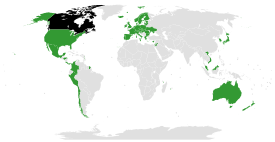
Free-trade agreements in force [edit]
- Source:[123]
- Canada–Israel Free Merchandise Agreement (Entered into force Jan 1, 1997, modernization ongoing)
- Canada–Republic of chile Complimentary Trade Agreement (Entered into strength July 5, 1997)
- Canada–Republic of costa rica Free Trade Agreement (Entered into forcefulness November 1, 2002, modernization ongoing)
- Canada–European Costless Trade Clan Gratis Merchandise Understanding (Iceland, Norway, Switzerland and Principality of liechtenstein; entered into force July 1, 2009)
- Canada–Peru Free Trade Agreement (Entered into strength August 1, 2009)
- Canada–Colombia Free Merchandise Agreement (Signed November 21, 2008, entered into force August 15, 2011; Canada's ratification of this FTA had been dependent upon Colombia's ratification of the "Agreement Concerning Almanac Reports on Human being Rights and Free Trade Between Canada and the Commonwealth of Republic of colombia" signed on May 27, 2010)
- Canada–Hashemite kingdom of jordan Gratis Trade Agreement (Signed on June 28, 2009, entered into strength October i, 2012)
- Canada–Panama Free Trade Agreement (Signed on May 14, 2010, entered into forcefulness April ane, 2013)
- Canada–Republic of korea Free Trade Agreement (Signed on March xi, 2014, entered into forcefulness January 1, 2015)
- Canada–Ukraine Free Trade Agreement (Signed 11 July 2016, entered into forcefulness August one, 2017)
- Comprehensive and Progressive Agreement for Trans-Pacific Partnership (signed March 8, 2018, entered into force December thirty, 2018)
- Canada-United States-Mexico Agreement (Signed November 30, 2018, entered into force July 1, 2020)
Costless-merchandise agreements no longer in force [edit]
- Source:[123]
- Canada–U.S. Costless Trade Agreement (Signed Oct 12, 1987, entered into force January 1, 1989, afterwards superseded by NAFTA)
- Trans-Pacific Partnership (concluded October 5, 2015, superseded by CPTPP)
- N American Complimentary Trade Agreement (Entered into force January 1, 1994, afterward superseded past CUSMA)
- Comprehensive Economic and Trade Understanding (ended August 5, 2014)
Ongoing free-trade agreements negotiations [edit]
- Source:[124]
Canada is negotiating bilateral FTAs with the post-obit countries respectively merchandise blocs:
- Caribbean area Customs (CARICOM)
- Republic of guatemala, Nicaragua and El salvador
- Dominican Commonwealth
- India
- Japan[125]
- Kingdom of morocco
- Singapore
- Andean Customs (FTA's are already in force with Peru and Colombia)
Canada has been involved in negotiations to create the following regional merchandise blocks:
- Canada and Central American Free Trade Agreement
- Costless Trade Surface area of the Americas (FTAA)
Political issues [edit]
Relations with the U.S. [edit]
Canada and the United states of america share a common trading human relationship. Canada's task market continues to perform well along with the U.s.a., reaching a thirty-twelvemonth depression in the unemployment rate in December 2006, following 14 consecutive years of employment growth.[126]

Flags of Canada and the United states of america
The Us is by far Canada's largest trading partner, with more than $1.seven billion CAD in trade per 24-hour interval in 2005.[127] In 2009, 73% of Canada's exports went to the United States, and 63% of Canada's imports were from the United States.[128] Merchandise with Canada makes up 23% of the United States' exports and 17% of its imports.[129] By comparison, in 2005 this was more than than U.S. trade with all countries in the European Union combined,[130] and well over twice U.S. merchandise with all the countries of Latin America combined.[131] Merely the two-mode trade that crosses the Administrator Bridge betwixt Michigan and Ontario equals all U.S. exports to Japan. Canada'southward importance to the United States is not just a border-country phenomenon: Canada is the leading export market for 35 of 50 U.Southward. states, and is the United States' largest strange supplier of energy.
Bilateral trade increased past 52% between 1989, when the U.S.–Canada Gratis Trade Understanding (FTA) went into effect, and 1994, when the North American Free Merchandise Understanding (NAFTA) superseded it.[ citation needed ] Trade has since increased by twoscore%. NAFTA continues the FTA's moves toward reducing trade barriers and establishing agreed-upon trade rules. It also resolves some long-standing bilateral irritants and liberalizes rules in several areas, including agriculture, services, free energy, financial services, investment, and government procurement. NAFTA forms the largest trading expanse in the globe, embracing the 405 million people of the 3 North American countries.
The largest component of U.South.–Canada trade is in the article sector.
The U.South. is Canada'southward largest agricultural consign market, taking well over half of all Canadian food exports.[132] Nearly ii-thirds of Canada's forest products, including pulp and newspaper, are exported to the Usa; 72% of Canada'southward total newsprint product likewise is exported to the U.South.
At $73.6 billion in 2004, U.South.-Canada merchandise in energy is the largest U.S. energy trading human relationship, with the overwhelming majority ($66.7 billion) existence exports from Canada. The chief components of U.S. energy trade with Canada are petroleum, natural gas, and electricity. Canada is the United States' largest oil supplier and the 5th-largest energy producing land in the world. Canada provides about sixteen% of U.South. oil imports and xiv% of total U.S. consumption of natural gas. The Usa and Canada's national electricity grids are linked, and both countries share hydropower facilities on the western borders.
While most of U.S.-Canada trade flows smoothly, at that place are occasionally bilateral trade disputes, particularly in the agricultural and cultural fields.[ citation needed ] Usually these problems are resolved through bilateral consultative forums or referral to World Trade Organization (WTO) or NAFTA dispute resolution.[ citation needed ] In May 1999, the U.S. and Canadian governments negotiated an agreement on magazines that provides increased access for the U.South. publishing industry to the Canadian market. The United States and Canada as well have resolved several major bug involving fisheries. By common agreement, the two countries submitted a Gulf of Maine boundary dispute to the International Courtroom of Justice in 1981; both accepted the court's October 12, 1984 ruling which demarcated the territorial sea boundary. A current issue betwixt the United States and Canada is the ongoing softwood lumber dispute, as the U.S. alleges that Canada unfairly subsidizes its forestry industry.[ citation needed ]
In 1990, the United States and Canada signed a bilateral Fisheries Enforcement Agreement, which has served to deter illegal line-fishing activity and reduce the take a chance of injury during fisheries enforcement incidents. The U.South. and Canada signed a Pacific Salmon Agreement in June 1999 that settled differences over implementation of the 1985 Pacific Salmon Treaty for the next decade.[133]
Canada and the The states signed an aviation agreement during Bill Clinton'south visit to Canada in Feb 1995, and air traffic betwixt the two countries has increased dramatically equally a result. The two countries likewise share in functioning of the St. Lawrence Seaway, connecting the Great Lakes to the Atlantic Bounding main.[134]
The U.S. remains Canada's largest foreign investor and the most popular destination for Canadian strange investments. In 2018, the stock of U.Southward. direct investment in Canada totaled $406 billion, while the stock of Canadian investment in the U.S. totaled $595 billion, or 46% of the overall CDIA stock for 2018.[135] [136] This made Canada the second largest investing state in the U.Southward. for 2018[137] US investments are primarily directed at Canada'due south mining and smelting industries, petroleum, chemicals, the industry of machinery and transportation equipment, and finance, while Canadian investment in the United States is concentrated in manufacturing, wholesale trade, real manor, petroleum, finance, insurance and other services.[138]
Debt [edit]
Canadian Regime Debt [edit]
Canadian regime debt, as well called Canada's public debt, is the liabilities of the government sector. For 2019 (the fiscal twelvemonth ending 31 March 2020), total financial liabilities or gross debt was $2434 billion for the consolidated Canadian general government (federal, provincial, territorial, and local governments combined). This corresponds to 105.three% every bit a ratio of GDP (Gross domestic product was $2311 billion).[139] Of the $2434 billion, $1146 billion or 47% was federal (key) government liabilities (49.6% as a ratio of GDP). Provincial government liabilities comprise most of the remaining liabilities.[139]
Some critics have raised concerns about the rising cost of servicing the Canadian government debt, saying that, despite historically low interest rates, interest payments on the public debt are expected to increment by 59.iv% in 2021.[140]
Household Debt [edit]
Household debt, the amount of money that all adults in the household owe fiscal institutions, includes consumer debt and mortgage loans. In March 2015, the International Monetary Fund reported that Canada's loftier household debt was one of two vulnerable domestic areas in Canada's economy; the 2d is its overheated housing marketplace.[141]
According to Statistics Canada, full household credit every bit of July 2019 was CAD$2.2 trillion.[142] Co-ordinate to Philip Cross of the Fraser Institute, in May 2015, while the Canadian household debt-to-income ratio is similar to that in the US, however lending standards in Canada are tighter than those in the The states to protect against loftier-risk borrowers taking out unsustainable debt.[143]
Mergers and Acquisition [edit]
Since 1985, 63,755 deals in- and outbound Canada have been announced,[ when? ] with an overall value of US$iii.7 billion.[144] About 50% of the targets of Canadian companies (outbound deals) have a parent company in the US. Inbound deals are 82% per centum from the US.
Here is a listing of the biggest deals in Canadian history:[144]
| Rank | Date announced | Acquiror name | Acquiror nation | Target name | Target nation | Value (in bil. USD) |
|---|---|---|---|---|---|---|
| 1 | January 26, 2000 | Spin-off | Canada | Nortel Networks Corp | Canada | 59.97 |
| 2 | June twenty, 2000 | Vivendi SA | France | Seagram Co Ltd | Canada | twoscore.43 |
| three | December 7, 2007 | Rio Tinto Canada Holdings Inc | Canada | Alcan Inc | Canada | 37.63 |
| four | June 9, 2016 | Enbridge Inc | Canada | Spectra Energy Corp | United States | 28.29 |
| five | March 12, 2014 | Enbridge Income Fund | Canada | Enbridge Inc-Liquids | Canada | 24.79 |
| 6 | November 5, 2008 | Shareholders | Canada | Cenovus Energy Inc | Canada | 20.26 |
| 7 | July 23, 2012 | CNOOC Canada Holding Ltd | Canada | Nexen Inc | Canada | xix.12 |
| 8 | May 15, 2006 | Xstrata PLC | Switzerland | Falconbridge Ltd | Canada | 17.xl |
| ix | November 8, 2006 | Cia Vale exercise Rio Doce SA | Brazil | Inco Ltd | Canada | 17.xv |
| 10 | March 23, 2009 | Suncor Energy Inc | Canada | Petro-Canada | Canada | fifteen.58 |
| eleven | July 29, 2008 | Teck Cominco Ltd | Canada | Fording Canadian Coal Trust | Canada | 13.threescore |
Encounter also [edit]
NB
PE
NS
YT
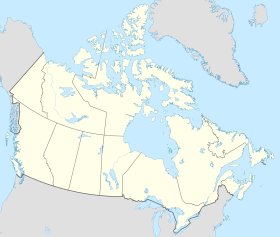
Economic system by province
- Canada's Global Markets Action Plan
- Comparing of Canadian and American economies
- Economy of Alberta
- Economy of Ontario
- Economy of Quebec
- Economic system of Saskatchewan
- History of the petroleum industry in Canada
- List of Median household income of cities in Canada
- Listing of Commonwealth of Nations countries by GDP
- Listing of Canadian provinces and territories by gross domestic product
Notes [edit]
- ^ The OECD produces an almanac report on member nations who share the goal of "contributing to the development of the earth economic system" past attaining the "highest sustainable economic growth and employment and a ascent standard of living while maintaining financial stability."
- ^ figures are for gross general government debt, as opposed to cyberspace federal debt; gross full general authorities debt includes both intragovernmental debt and the debt of public entities at the sub-national level
- "Gross domestic product (Gross domestic product) at basic prices, by industry". www150.statcan.gc.ca. January 31, 2013.
References [edit]
- ^ "Globe Economical Outlook Database, April 2019". IMF.org. International Monetary Fund. Retrieved September 29, 2019.
- ^ "Globe Bank Land and Lending Groups". datahelpdesk.worldbank.org. World Depository financial institution. Retrieved September 29, 2019.
- ^ "Population estimates, quarterly". statcan.gc.ca. Statistics Canada. March 17, 2022. Retrieved March nineteen, 2022.
- ^ a b c d e "Globe Economic Outlook Database, April 2022". International monetary fund.org. International monetary fund. Retrieved January 17, 2022.
- ^ a b c d e "The Globe Factbook". CIA.gov. Primal Intelligence Agency. Retrieved October 8, 2019.
- ^ Government of Canada, Statistics Canada (December fifteen, 2021). "The Daily — Consumer Price Index, December 2021".
- ^ Regime of Canada, Statistics Canada (March 23, 2022). "The Daily — Canadian Income Survey, 2020". www150.statcan.gc.ca . Retrieved March 24, 2022.
- ^ "Trudeau's Scattershot Spending Sends Child Poverty to New Lows - BNN Bloomberg". March 24, 2022.
- ^ "Gini coefficients of adjusted market, total and after-tax income". July 8, 2015.
- ^ "Human Development Alphabetize (HDI)". hdr.undp.org. HDRO (Human Development Report Office) United Nations Development Programme. Retrieved Dec 11, 2019.
- ^ "Inequality-adjusted HDI (IHDI)". hdr.undp.org. UNDP. Retrieved May 22, 2020.
- ^ a b c "Labour force characteristics, monthly, seasonally adjusted and trend-cycle, concluding v months". statcan.gc.ca. Statistics Canada. Retrieved October 10, 2020.
- ^ https://www.cbc.ca/news/business concern/jobs-march-canada-1.6413073[ bare URL ]
- ^ "Unemployment charge per unit by age group". data.oecd.org. OECD. Retrieved Dec 9, 2021.
- ^ "Payroll employment, earnings and hours, September 2019". Statistics Canada. Dec 19, 2019.
- ^ "Ease of Doing Business in Canada". Doingbusiness.org. Retrieved November 24, 2017.
- ^ "The International Trade Explorer, 2021". Statcan.gc.ca. September iv, 2019. Retrieved March 21, 2022.
- ^ a b "Canada - WTO Statistics Database". World Trade Organization. Archived from the original on September six, 2017. Retrieved March one, 2017.
- ^ "The International Trade Explorer, 2021". Statcan.gc.ca. September 4, 2019. Retrieved March 21, 2022.
- ^ a b "The Globe Factbook". CIA.gov. Central Intelligence Agency. Retrieved April 6, 2019.
- ^ "Canada'south balance of international payments, third quarter 2021". Statcan.gc.ca. Retrieved January xx, 2021.
- ^ "Statistics Canada". December 9, 2021. Retrieved January xx, 2021.
- ^ "Financial indicators of general government sector, national balance canvas accounts". October 15, 2012.
- ^ "Development aid rises once again in 2016 but flows to poorest countries dip". OECD. April 11, 2017. Retrieved September 25, 2017.
- ^ "Sovereigns rating list". Standard & Poor'south. Retrieved January xiv, 2012.
- ^ "Moody'southward Affirms Canada'southward Aaa Rating; Maintains Stable Outlook". Moody'southward Investors Service. Nov ii, 2016. Retrieved September 23, 2017.
- ^ "Fitch Downgrades Canada's Ratings to 'AA+'; Outlook Stable". Retrieved June 24, 2020.
- ^ "Archived copy". Archived from the original on September 6, 2017. Retrieved September 6, 2017.
{{cite web}}: CS1 maint: archived copy as title (link) - ^ "International Reserves and Foreign Currency Liquidity - CANADA". www.international monetary fund.org.
- ^ Hall, Peter A.; Soskice, David (2001). Varieties of Capitalism: The Institutional Foundations of Comparative Advantage. Oxford Academy Printing. p. 570. ISBN9780191647703.
- ^ "Commercialism in Canada". The Canadian Encyclopedia . Retrieved April 24, 2022.
- ^ "Bodily hours worked per week past manufacture, seasonally adjusted crack". Statistics Canada. Archived from the original on November 3, 2008.
- ^ Anthony, Craig (September 12, 2016). "10 Countries with the Most Natural Resources". Investopedia.
- ^ Rotberg, Robert I.; Carment, David (2018). Canada's Corruption at Home and Abroad. Taylor & Francis. p. 12. ISBN978-1-351-57924-seven.
- ^ "Latest release". World Merchandise Organization. April 17, 2008. Archived from the original on June 5, 2011. Retrieved May 23, 2011.
- ^ "Index of Globalization 2010". KOF. Archived from the original on May 31, 2012. Retrieved May 22, 2012.
- ^ "Index of Economic Liberty". The Heritage Foundation-The Wall Street Journal. 2013. Archived from the original on June 29, 2013. Retrieved June 27, 2013.
- ^ "Jonathan Kay: The central to Canada's economic advantage over the United States? Less income inequality". National Post. December 13, 2012. Archived from the original on May xv, 2016. Retrieved December 14, 2012.
- ^ OECD (June 16, 2017). Better Policies Policies for Stronger and More Inclusive Growth in Canada. OECD Publishing. pp. 3–. ISBN978-92-64-27794-6.
- ^ "Monthly Reports - World Federation of Exchanges". WFE. as of Nov 2018[update]
- ^ a b c "U.S.-Canada Merchandise Facts". Canada's State of Trade (xx ed.). Global Affairs Canada. 2021. ISSN 2562-8313. PDF version
- ^ [i] Archived May 12, 2013, at the Wayback Machine
- ^ "Aquaculture Canada: Facts and Figures". Dfo-mpo.gc.ca. February 2, 2011. Archived from the original on June 15, 2012. Retrieved February 1, 2013.
- ^ "Canada's Amusement Software Industry In 2011 A Report Prepared For The Entertainment Software Association Of Canada" (PDF). Archived from the original (PDF) on May 7, 2013. Retrieved February 5, 2016.
- ^ a b Global Systems past David J Rees with Michael G Jones, Chapter iv, ISBN 0-919913-74-one
- ^ "Crown Land | The Canadian Encyclopedia". www.thecanadianencyclopedia.ca . Retrieved January i, 2021.
- ^ Central Intelligence Bureau (May 16, 2006). "The Earth Factbook: Canada". Central Intelligence Agency. Retrieved May 6, 2007.
- ^ "The Globe's Largest Public Companies". Forbes.
U.South. companies account for the nigh members of the list, 565, followed by Mainland china and Hong Kong, which is home to 263 Global 2000 companies.
- ^ a b "Exports of appurtenances on a balance-of-payments basis, by product". Statistics Canada. Archived from the original on Nov two, 2011.
- ^ "Imports, exports and merchandise residue of goods on a residuum-of-payments basis, past country or country group". Statistics Canada. Archived from the original on June 18, 2006.
- ^ Canada'due south Private to Public (Crown) Property Ratio is threescore:forty.2006 exports/imports
- ^ "Gross domestic production at basic prices, by industry (monthly)". Statistics Canada. Archived from the original on April 28, 2011.
- ^ Howlett, Michael and M. Ramesh. Political Economy of Canada: An Introduction. Toronto: McClelland and Stewart, 1992.
- ^ "Report for Selected Countries and Subjects". International monetary fund . Retrieved February 7, 2022.
- ^ Canada, Government of Canada, Statistics (September 2021). "Labour force characteristics past province, monthly, seasonally adapted". www150.statcan.gc.ca . Retrieved April 10, 2022.
- ^ Workman, Daniel (March 23, 2021). "Canada's Top Trading Partners". Earth's Elevation Exports.
- ^ "Canada: Trade Statistics". Michigan Country University.
- ^ a b 'OECD Compendium of Productivity Indicators 2012 (Report). OECD. 2012. page iii
- ^ OECD Economic Surveys Canada June 2012 Overview (PDF) (Report). System for Economic Co-functioning and Development. 2012. Archived (PDF) from the original on June sixteen, 2013.
- ^ OECD Compendium of Productivity Indicators 2021 (Report). System for Economic Co-performance and Development.
{{cite report}}: CS1 maint: url-condition (link) - ^ OECD Canada Economic Survey 2018 (Report). Organisation for Economical Co-operation and Development.
{{cite report}}: CS1 maint: url-status (link) - ^ OECD Canada Economic Survey 2021 (Study). Organisation for Economic Co-operation and Development.
{{cite report}}: CS1 maint: url-status (link) - ^ "Bank of Canada". www.bankofcanada.ca.
- ^ a b c d e f Monetary Policy Report (PDF) (Study). July 15, 2015. Retrieved August half-dozen, 2015.
- ^ a b c Blake, ed. (2007), Transforming the Nation: Canada and Brian Mulroney
- ^ Aggrandizement-Control Target Backgrounder (PDF), Bank of Canada, Nov 2010
- ^ Poloz, Stephen S. (January 9, 2019). "Opening Statement" (Press release). Monetary Policy Report. Ottawa, Ontario: Banking company of Canada. Retrieved January 9, 2019.
- ^ a b c d Jeremy Torobin; Pecker Curry (October xvi, 2011), Depository financial institution of Canada to get marching orders to expect beyond inflation targeting, Ottawa, Ontario: The Earth and Mail
- ^ Budgetary Policy Report (Report). Banking company of Canada. April 2009. Retrieved August 6, 2015.
- ^ a b Bank of Canada lowers overnight charge per unit target to 1/2 per cent, Bank of Canada, retrieved Baronial half-dozen, 2015
- ^ David Parkinson (July ix, 2015), IMF again cuts Canada's growth forecast ahead of interest charge per unit decision, The Globe and Mail, retrieved August 6, 2015
- ^ Lampert, Allison (July 15, 2015), After charge per unit cut, Canada PM's function says global woes hit economy, Reuters, retrieved Baronial 7, 2015
- ^ Chris Sorensen; Aaron Hutchins (July 15, 2015), How Canada'due south economy went from blast to recession so fast: An in-depth look at the perfect storm that pushed Canada into recession, Macleans, retrieved August 8, 2015
- ^ "Inflation-Control Target".
- ^ "The Banking company of Canada Shows Information technology'southward the Federal Reserve of the North". Bloomberg.com. July 12, 2017.
- ^ "Bank of Canada Raises Rates for First Time in 7 Years". Bloomberg.com. July 12, 2017.
- ^ "Bank of Canada raises involvement rates for outset fourth dimension in 7 years".
- ^ "GESSAROLI: Artificially low interest rates -- we're paying the price". torontosun . Retrieved Apr 1, 2022.
- ^ a b c Gross domestic product (Gross domestic product) at basic prices, by industry, annual average (x 1,000,000), Statistics Canada, Table 36-10-0434-03, 2018.
- ^ "CIA World Factbook - Canada". Cia.gov. Retrieved Oct 14, 2018.
- ^ Wallace, Iain, A Geography of the Canadian Economic system. Don Mills: Oxford Academy Press, 2002.
- ^ Government of Canada, Statistics Canada (January 25, 2021). "Labour forcefulness characteristics by industry, annual". www150.statcan.gc.ca.
- ^ "Canada Business Facts".
- ^ Gasher, Mike (2002). Hollywood North the feature motion-picture show industry in British Columbia. Vancouver: UBC Press. ISBN978-0774809689.
- ^ MacLaurin, Tanya; MacLaurin, Donald (2003). "Casino gaming and tourism in Canada". International Journal of Contemporary Hospitality Management. MCB Upwardly Ltd. 15 (6): 328–332. doi:10.1108/09596110310488177.
- ^ a b "Manufacturing's share of gross domestic production, 1900 to 2005". Statistics Canada.
- ^ "The Canadian Manufacturing Sector: Adapting to Challenges". Statistics Canada.
- ^ "Global Steel Trade Monitor - Steel Exports Study: Canada" (PDF). US Department of Commerce. International Trade Assistants. August 2019. Archived from the original (PDF) on April 28, 2018. Retrieved Oct 10, 2019.
 This article incorporates text from this source, which is in the public domain .
 - ^ a b c "Greenhouse gas sources and sinks: executive summary 2019". aem. Environment and Climatic change Canada. August xix, 2019. Archived from the original on April 7, 2020. Retrieved March 31, 2020.
- ^ "USGS Platinum Production Statistics" (PDF).
- ^ "USGS Gold Production Statistics" (PDF).
- ^ "USGS Nickel Product Statistics" (PDF).
- ^ "USGS Copper Production Statistics" (PDF).
- ^ "USGS Atomic number 26 Ore Production Statistics" (PDF).
- ^ "USGS Titanium Product Statistics" (PDF).
- ^ "USGS Potash Production Statistics" (PDF).
- ^ "USGS Niobium Production Statistics" (PDF).
- ^ "USGS Sulfur Production Statistics" (PDF).
- ^ "USGS Molybdenum Production Statistics" (PDF).
- ^ "USGS Cobalt Production Statistics" (PDF).
- ^ "USGS Lithium Production Statistics" (PDF).
- ^ "USGS Zinc Production Statistics" (PDF).
- ^ "USGS Gypsum Product Statistics" (PDF).
- ^ "USGS Antimony Product Statistics" (PDF).
- ^ "USGS Graphite Production Statistics" (PDF).
- ^ "USGS Salt Production Statistics" (PDF).
- ^ "World Uranium Mining - World Nuclear Association". www.world-nuclear.org.
- ^ "Resources-based Industries and High-tech Manufacturing - Appurtenances Sector - Major Industries - A Guide to the BC Economic system and Labour Market". Guidetobceconomy.org. Archived from the original on September 7, 2011. Retrieved November two, 2011.
- ^ Canadian, The (October 4, 2011). "Aluminum heavyweights to make $15-billion Quebec investment". Canadian Manufacturing. Archived from the original on October 13, 2011. Retrieved November 2, 2011.
- ^ Environment Canada - Energy Consumption Archived February 22, 2004, at the Wayback Machine
- ^ "Canada vs. The OECD: An Environmental Comparing". Environmentalindicators.com. Retrieved February 22, 2011.
- ^ a b "Greenhouse gas emissions". Canada.ca. Environs and Climate change Canada. January 9, 2007. Archived from the original on April 11, 2020. Retrieved March 31, 2020.
- ^ Natural Resources Canada (October 6, 2017), Electricity Facts, archived from the original on May ane, 2019, retrieved March 31, 2020
- ^ International Free energy Agency, Key World Energy Statistics 2010 (PDF), Paris: IEA/OECD, p. 19, archived from the original (PDF) on October 11, 2010, retrieved September vii, 2010
- ^ "Top fifteen Nuclear Generating Countries". Nuclear Energy Institute. Retrieved March 31, 2019.
- ^ Natural Resources Canada (January 30, 2018), Reducing diesel fuel energy in rural and remote communities
- ^ Lee Greenberg (July 20, 2011). "Growing Equalization Payments to Ontario Threaten Land". National Post.
- ^ Michel Beine; Charles S. Bos; Serge Coulombe (January 2009). "Does the Canadian economic system suffer from Dutch Disease?" (PDF). Archived from the original (PDF) on November 17, 2011.
- ^ "National Energy Program", The Canadian Encyclopedia. Historica Foundation of Canada, Jan 2005, archived from the original on May 19, 2018, retrieved March 31, 2020
- ^ Gerson, Jen (September xiv, 2012), "A legacy rich as oil: Ex-Alberta premier Peter Lougheed'south ideas imprinted on party however in power 41 years later", National Post , retrieved February 3, 2015
- ^ "The Relative Position of Canada in the World Grain Market". Dsp-psd.pwgsc.gc.ca. October two, 2002. Retrieved February 22, 2011.
- ^ "Agriculture and Agri-Food Economic Account, 2015". Statistics Canada. July xxx, 2019. Retrieved July thirty, 2019.
- ^ a b "Trade and Investment Agreements". Global Diplomacy Canada. Authorities of Canada. Feb ten, 2017. Archived from the original on February 12, 2017. Retrieved August 18, 2020.
- ^ "Canada'south Free Trade Agreements". International.gc.ca. Archived from the original on March 12, 2014. Retrieved March 11, 2014.
- ^ The Canadian Press (February 24, 2011). "Canada, Japan study free-trade pact". CBC News. Retrieved Feb 28, 2011.
- ^ "The Daily, Friday, Jan v, 2007. Labour Force Survey". Statcan.ca. January five, 2007. Archived from the original on May 28, 2008. Retrieved February 22, 2011.
- ^ "Canadian Statistics -- Imports, exports and trade balance of appurtenances on a residual-of-payments ground, by land or country group". Archived from the original on June xviii, 2006.
- ^ "Imports, exports and trade rest of goods on a balance-of-payments footing, by land or country grouping". 0.statcan.gc.ca. Feb 11, 2011. Archived from the original on Apr 28, 2011. Retrieved February 22, 2011.
- ^ FTDWebMaster, [Name of person creating HTML]. "FTD - Statistics - Trade Highlights - Peak Trading Partners". Census.gov. Retrieved February 22, 2011.
- ^ FTDWebMaster, FTD Data Dissemination. "FTD - Statistics - Country Data - U.S. Trade Rest with European Union". Census.gov. Retrieved February 22, 2011.
- ^ FTDWebMaster, FTD Data Dissemination. "FTD - Statistics - State Data - U.S. Trade Residue with South and Central America". Census.gov. Retrieved Feb 22, 2011.
- ^ Agriculture and Agri-Nutrient Canada / Agriculture et Agroalimentaire Canada Archived September 28, 2006, at the Wayback Motorcar
- ^ "The Pacific Salmon Treaty: The 1999 Understanding and Renegotiated Annex IV". EveryCRSReport.com. May five, 2009.
- ^ "HowStuffWorks "The St. Lawrence Seaway"". Geography.howstuffworks.com. March 30, 2008. Archived from the original on July 12, 2011. Retrieved February 22, 2011.
- ^ "Canada's Country of Trade 2019" (20th ed.). Global Diplomacy Canada. August 2, 2019. Retrieved September 26, 2019.
- ^ "Canada's State of Merchandise 2019" (20th ed.). Global Affairs Canada. August 2, 2019. Retrieved September 26, 2019.
- ^ "Directly Investment by Country and Manufacture, 2018". Bureau of Economical Analysis. July 24, 2019. Retrieved September 26, 2019.
- ^ "Overview of Canadian Foreign Direct Investment (PRB-0833E)". .parl.gc.ca. June 17, 2008. Archived from the original on May two, 2010. Retrieved February 22, 2011.
- ^ a b Statistics Canada, The Daily (Nov xviii, 2020). "Largest arrears in seven years in 2019; full impact of pandemic yet to be seen".
- ^ "GOLDSTEIN: Servicing public debt eroding nation's finances -- report". torontosun . Retrieved March 25, 2022.
- ^ "2015 Report of the International Budgetary Fund", International Budgetary Fund, March 9, 2015
- ^ Statistics Canada (July 2019), Credit measures, Bank of Canada (x one,000,000) , retrieved September 15, 2019
- ^ Philip Cross (May 2015), A Longer-term Perspective on Canada's Household Debt (PDF) , retrieved August vii, 2015 [ permanent dead link ]
- ^ a b "M&A Canada - Mergers & Acquisitions Statistics". IMAA-Establish . Retrieved February 22, 2018.
Further reading [edit]
- Howlett, Michael and M. Ramesh. Political Economy of Canada: An Introduction. Toronto: McClelland and Stewart, 1992.
- Wallace, Iain, A Geography of the Canadian Economy. Don Mills: Oxford Academy Press, 2002.
- "OECD Economical Surveys: Canada 2010", Organización para la Cooperación y Desarrollo Económicos, Paris : OECD economical surveys, 2010, ISBN978-92-64-08325-7
- Baldwin, John Russel (2003), Innovation and knowledge cosmos in an open up economic system, Cambridge University Press, ISBN0-521-81086-8
- Easterbrook, William Thomas; Aitken, Hugh One thousand. J (1988). Canadian Economical History. Academy of Toronto Printing. ISBN0-8020-6696-8.
- Hessing, Melody; Michael Howlett, Tracy Summerville (2005), Canadian natural resource and environmental policy, UBC Printing, ISBN9780774851459
- Kealey, Gregory S (1995), Workers and Canadian history, McGill-Queen's University Press, ISBN0-7735-1352-3
- Levi, Michael A (2009), The Canadian oil sands : free energy security vs. climate change, Council on Foreign Relations, Centre for Geoeconomic Studies, ISBN978-0-87609-429-7
- Lipsey, Richard G; Alice Nakamura, Canada. Industry Canada (2006), Services industries and the knowledge-based economy, University of Calgary Press, ISBN1-55238-149-eight
- Pomfret, Richard (1981), "The Economic Development of Canada", revised 2005, Routledge, ISBN978-0-415-37976-2
- Quarter, Jack; Laurie Mook, Ann Armstrong (2009), Understanding the Social Economy: A Canadian Perspective, University of Toronto Press, ISBN978-0-8020-9695-1
- Tavidze, Albert (2007), Progress in Economic science Research, Book 12, Gardners Books, ISBN978-1-60021-720-3
External links [edit]
- Statistics Canada
- Department of Finance Canada
- Bank of Canada
- Canada - OECD
- Canada contour at the CIA World Factbook
- Canada profile at The World Bank
- Canada Exports and Imports

Who Consumes Goods And Services In Canada,
Source: https://en.wikipedia.org/wiki/Economy_of_Canada
Posted by: bushcraight.blogspot.com
0 Response to "Who Consumes Goods And Services In Canada"
Post a Comment